
This is one of those dense, evocative films that will sweep you up whilst also leaving you not sure of what you’ve just seen.
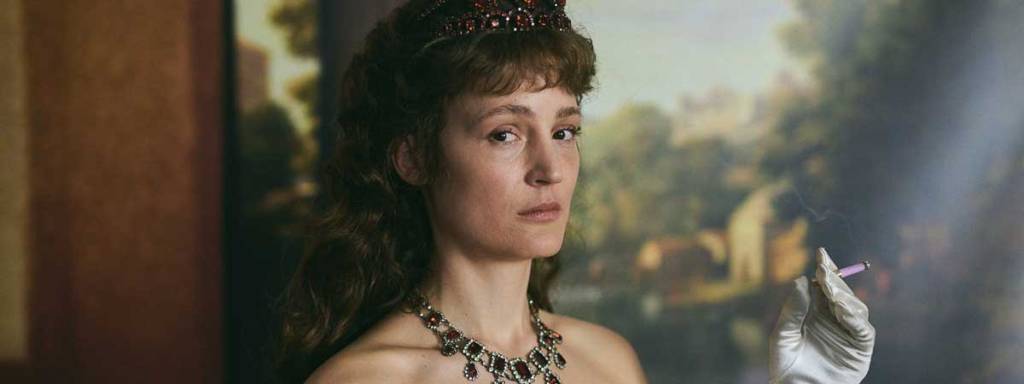
Ostensibly about Empress Elisabeth of Austria (and Queen of Hungary), it is a kind of biopic albeit with a large dollop of metaphor. Set over a year in 1878, Elisabeth (Vicky Krieps) is 40 and ill-suited t life as a regent. She obsesses about her weight (as does everyone else), eats nothing, faints often (although this may be a way to get out of boring official duties), and has her corset – corsage – laced tighter every day. She’s a restless spirit, always wanting to be somewhere else in a world where everything she does is scrutinised. Although tonally the two films are very different, I couldn’t help but be reminded of Spencer (2021) and Princess Diana’s trauma under the microscope of royal tradition and expectation.
What is clear to a modern audience is that Elisabeth has serious depression and no amount of chivvying, warm baths or logical arguments will change that. She seems disconnected from everyone with few feelings of empathy yet she craves the human contact of an embrace. Her husband Franz Joseph (Florian Teichtmeister) copes by distancing himself physically and emotionally and even her beloved son Rudolf isn’t enough to bring her joy.
Stylistically, director Marie Kreutzer makes an interesting choice that elevates this from a simple retelling – small anachronisms begin to creep in. You might not notice them at first – a telephone, a lamp, a tractor – but by the end it is impossible to ignore them. These are nods, perhaps, to Elisabeth’s modernism – she smokes, rides, wears simple, unfussy clothes and wants a purpose in life, all things women weren’t supposed to do. The end credits hint at another possibility or maybe a metaphor around gender. In many ways the power of the ending – the last scene and the credits – transform the film.
Krieps is mesmerising as the not always likeable heroine. Reading up on Elisabeth afterward, the narrative is remarkably faithful, which clarifies that the anachronisms and Elisabeth’s fate as we see it are metaphorical or lyrical. Interesting, and perhaps significant to the title of the film, her corset played a role in her death, aged 60 at the hands of an Italian anarchist. The needle he stabbed her with as she walked without an entourage penetrated her heart but the tightness of her corset kept her alive and walking until it was unlaced.
This won’t be a film for everyone. It’s slow, beautiful and repetitive but it’s bound to stay with you after the lights go up.
Have you seen this film? Let me know your thoughts.
 fillums
Pingback: La Chimera (2023) | fillums