A gentle love letter to Melbourne that will make you look up with a new appreciation of what you probably walk past every day.
Every city has its story of architectural boom and bust and for Melbourne, it hinges on the glory of Victorian era pride and affluence and the tragedy of the inevitable cultural cringe.
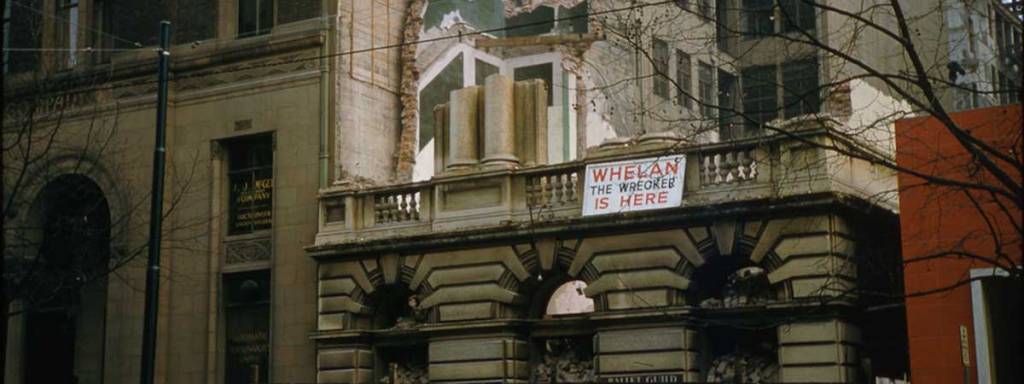
A building height limit through the 19th and half of the 20th century saw Melbourne CBD as a compact and grand arena where class was clearly defined – Collins St was posh, Bourke St was working class. Anyone who lived through the 1970s and 80s knows how fashion can go from the height of cool to the depths of embarrassment and then be rediscovered by the next generation. It was the same for Melbourne’s architecture, the grand Victorian mansions and offices – one built with artisan expertise to ‘outlast the pyramids’ – became unfashionable, unheatable, and uncommercial by the 50s and in a crazed cloud of dust, were demolished by Whelan the Wrecker. Luckily, by the mid 70s, people began to notice and heritage laws were put in place to (mostly) save what was left.
Gus Berger’s documentary gives us a warm and engaging overview of 150 years, with experts in history, architecture, photography and cinema narrating the different threads of change. There are plenty of photographs and film footage to show us what Melbourne was like and this is at its most effective when historical and contemporary imagery is juxtaposed. The narrators are all obviously passionate about their topic, with Robyn Annear bringing a particular dry humour to her stories.
One thread is the boom and bust of cinema (not surprising considering Berger’s role in the revival of a Thornbury arthouse cinema), with the first 50 years of the 20th century seeing more than 100 cinemas established across the CBD and suburbs. I wonder if those picture palaces and chains like Hoyts had any concept in the 50s at how swiftly television would cause their empires to crumble. It’s heartbreaking to see these glorious Art Deco buildings and interiors crushed into rubble, to be replaced by drab supermarkets and offices. Imagine if the Padua had been preserved!
It makes you appreciate the surviving cinemas and theatres that have weathered the changes in how we like to be collectively entertained. Thank goodness for the Forum and Capitol (no mention of the awfully uncomfortable seats), for the preservation of the Astor and Westgarth, for Michael Smith’s belief in the Sun Cinema and Berger for the Thornbury Picture House.
Although we end with the gutting of the iconic music venue, the Metro in Bourke St – it’s where I saw the Violent Femmes and Everything But the Girl – and the bittersweet realisation that heritage laws apply only to the facade, there is hope along side the sadness.
This documentary is a poignant pairing with Franklin (2022) where the notion of preservation of heritage is turned up to 11.
Have you seen this film? Let me know your thoughts in the comments below.
 fillums