
With conductor, Marin Alsop‘s anti-women criticism running around my head and the film’s esoteric trailer looking a tad film school, my expectations were low.
My daughter and I even devised codes to signal a joint decision to bail early after we both sat bored through the interminableThe Banshees of Inisherin.* So I was utterly surprised that I couldn’t take my eyes off the screen for Todd Field’s 2.5 hours of textured and mostly believable story of power and narcissism.
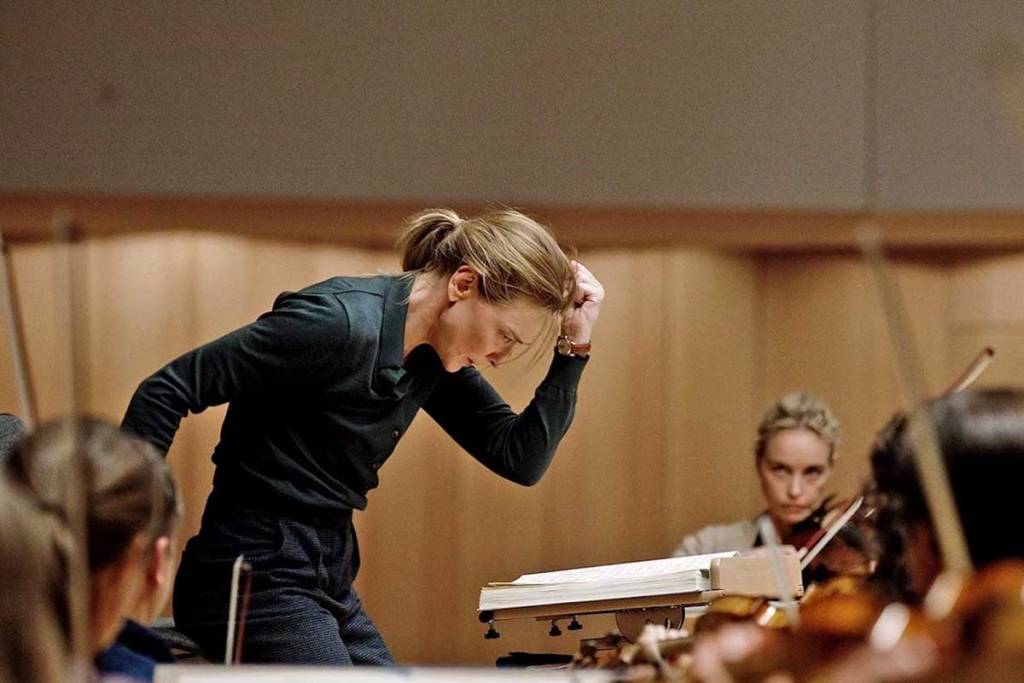
Written for Cate Blanchett, and she is mesmerising as lauded conductor, Lydia Tár, an American who climbed her way to fame and is the first female director of a major German orchestra. She leads the Berlin Philharmonic with skill and the force of her personality and lives with her partner, First Violinist Sharon (Nina Goodnow), and child in Berlin.
We meet her at the height of career success. She has a book about to be released and is preparing to complete a series of Mahler performances. She is interviewed by the New Yorker, is on podcasts, and deals with the politics of donors, management, rivals, and hangers on.
Sharon is a stillpoint in the glorious maelstrom of her life, accommodating of her ego and willing to turn a blind eye to Lydia’s tendency to elevate young women who she finds attractive. Lydia’s assistant Francesca (Noémie Merlant) was perhaps one of those and she deals with the drudgery of her job and Lydia’s caprice, in the hope that the assistant conductor job might one day be hers.
And this is what Field and Blanchett so successfully explore – the power that comes with privilege and the destructive force of leadership without empathy.
I can understand Allsop’s chagrin, that abuse of power is being characterised by a queer woman and not a straight white man, which would be much closer to reality. I wonder too if Lydia’s character is a bit too similar to Allsop‘s own life.
I agree with this in principle, but felt that making the same film about a male character would have overshadowed the subtleties that come with workplace manipulation. It would be easier to dismiss it as ‘all men’ or #notallmen and characterising it in a way we don’t expect lays bare exactly how it manifests.
Lydia is like a storm cloud you can’t look away from. She doesn’t see herself as a perpetrator of patriarchy, she is lauded as someone who has overcome gender boundaries and, for a while, we believe her. The clues are subtle at first – the almost invisible manoeuvering to cull any competition for her status, the single-take Juilliard class where she uses language and status like a battering ram to silence dissent.
The effect of accountability on Lydia is one of the most powerful scenes. It felt jarring, and in someways narratively convenient rather than likely, but if you have ever seen a narcissist/sociopath unmasked, the explosive anger and inability to control emotions will seem familiar.
Overall, this feels on a par with She Said (2022) for genuinely engaging with the realities of abuse of power in the #metoo era.
*By the way, our code words were ‘the rabbit of chaos’ and ‘the ferret of disorder.’
Image via http://www.vaguevisages.com
Have you seen this film? Let me know your thoughts in the comments below.
 fillums