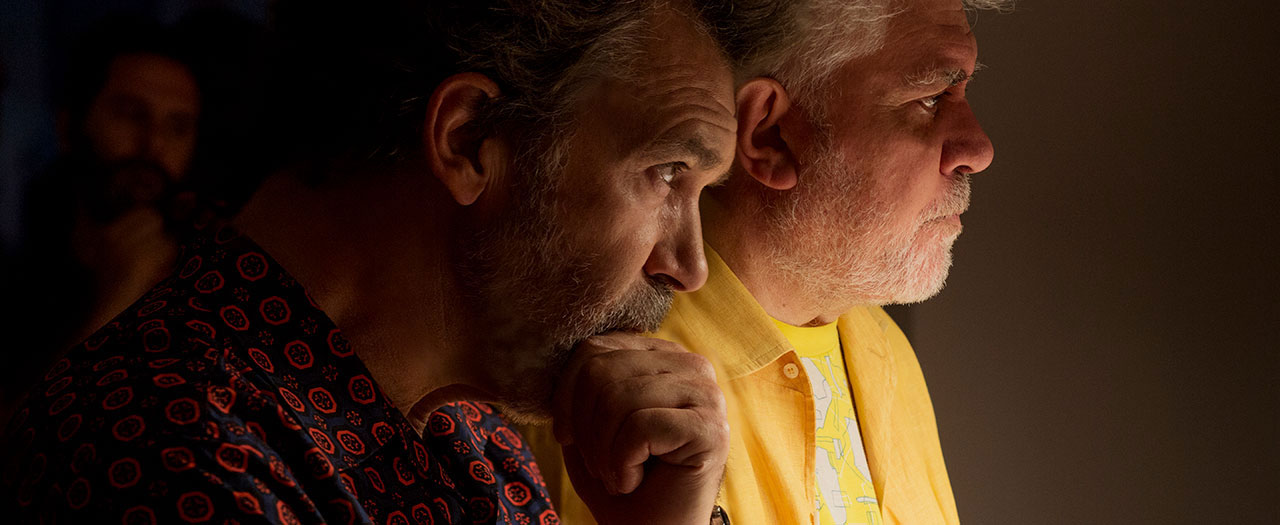

I was a bit trepidatious about seeing Almodóvar’s latest (in 2019 – it’s taken me a while to post this!).
His early films taught me a lot about storytelling, cinema and melodrama. His characterisation of strong women was always interesting, although sometimes I felt alienated by the intensity and magnification of femininity.
His last, Julieta (2016), didn’t do it for me – the melodrama for the first time feeling thin and pointless. With Pain and Glory, Almodóvar is being praised for finally representing his own life in a story of a director facing ageing and his past.
As his character, Salvador (Antonio Banderas) says, “it is autofiction”, and it’s clear that we may draw much from this film that might be true. In Almodóvar style, it is presented as a rich and supersaturated montage that echoes memory and dreams.
We see two time periods; Salvador ageing and Salvador as a child, living in rustic poverty with his mother (Penelope Cruz), and an absent father. We flit back and forth as the adult Salvador, now a famous director, slips into reveries. We see the spark of love for cinema, for beautiful men, the stories and the written word and for his mother. There are some beautiful scenes, such as his mother and other women washing sheets in a sun-drenched river.
The older Salvador is a bit of a grumpy entitled mess. He has not spoken to an actor from one of his most lauded films for 30 years. They reconnect and we find out how much Salvador struggles with fame and expectation and can’t seem to bring himself to start another film.
He lives in a gorgeous apartment, full of art – Almodóvar’s own and with a seriously gorgeous kitchen – and although we shouldn’t like him, it’s hard not to be won over by Banderas’s hangdog charm.
Afterward, I thought of the similarities between this and Joanna Hogg’s The Souvenir (2019). Both are somewhat autobiographical, from white directors who have passed middle-age, and focus on filmmaking, creative blocks, impostor syndrome, and past mistakes. They are very different in style, but I couldn’t help noticing that Almodóvar provides a redemption for himself that Hogg doesn’t. Salvador is forgiven his past by all, and it feels like there is an ever present ego there that is showing us only a stylish, curated truth.
Nonetheless, it’s an engaging story told well. For once, there’s not much melodrama, just quiet emotion. And that last shot has a magic that casts the whole film in a different light. It’s elegant.
Image via miff.com.au
 fillums
Pingback: The Room Next Door (2024) | fillums