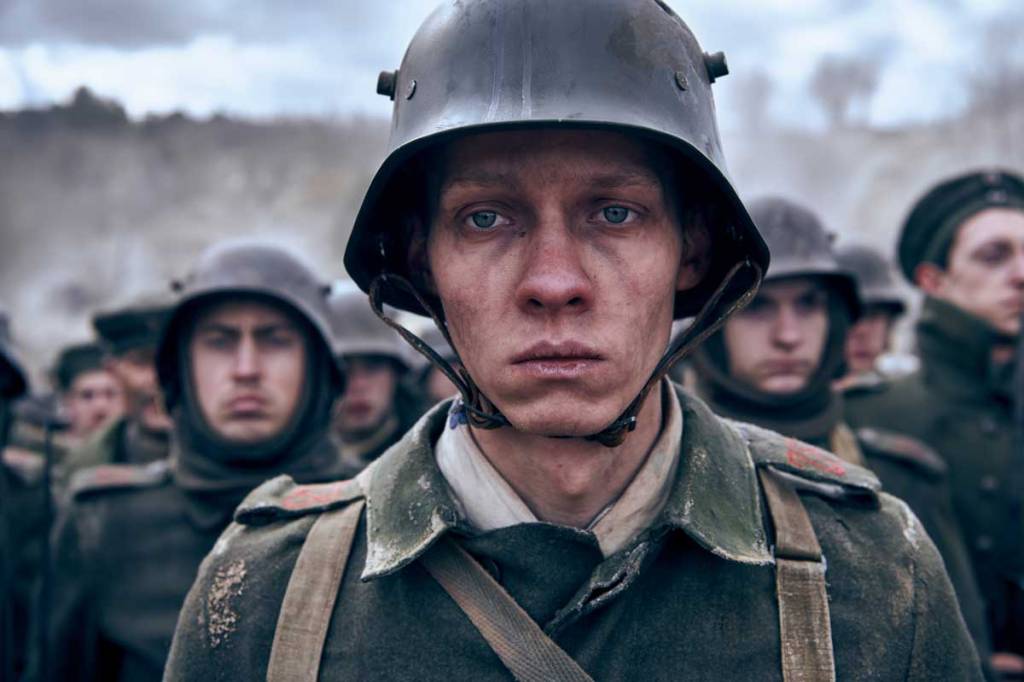

If you are looking for a film that relentlessly depicts the awful hopelessness of war, Edward Berger’s re-adaptation of Erich Remarque’s novel is the one to watch.
I remember really loving the first adaptation of this novel, the 1930 American-made Lewis Milestone version with the same title. Looking at the trailer now, it seems full of melodrama and American accents. It was banned in Germany by the Nazi party for showing the German soldiers as ‘cowards’ and is remarkable for its level of violence for a film of the time, and its relatively honest depiction of the realities for soldiers at war. We screened this version at our local Film Society many years ago and our local newspaper helpfully titled the small article they wrote about the screening as “Film Society screens Western.”
Berger’s film thankfully is German made and cast (and won the Best Foreign Language Oscar). It doesn’t shy away from showing the fear that so many young man would have felt, the brutality of having to fight an enemy, and the awful pride of those with the power to stop it.
The story is about a group of young German men, barely 18, excited to volunteer to fight in the final stages of World War I. Paul (Felix Kammerer) is lanky and wide-eyed and falsifies his parents’ signatures on his papers so that he can fight with his friends Albert (Aaron Hilmer), Franz (Moritz Klaus), and Ludwig (Adrian Grünewald).
We start the film, though, with another young man in a trench, being ordered to go over the top to his certain death. We follow his muddy bullet ridden woollen coat as it is removed from his body, transported, cleaned, mended, and then re-issued to Paul. With this almost wordless intro, we understand that these fresh young men are indeed cannon fodder.
The Western front in WWI epitomised a war of attrition, where each side tries to wear the other down by killing as many people as possible. Over the four years of the war, barely any ground was gained or lost on the Western front, there were no glorious victories to boost the morale of the population, hence it was reported in the papers as “nothing new in the west” (the literal translation of the German title) or “all quiet on the Western front.”
It was anything but quiet, though. As you can imagine, those fresh-faced young lads were dropped into a dystopian nightmare of mud, bodies, starvation, and the real possibility of unexpected death at any time. That they were days away from the Armistice makes it all the more poignant and bleak.
There is camaraderie and moments of lightness, such as when Paul and fellow soldier Katczinsky (Albrecht Schuch) raid a nearby French farm to steal a goose. There are no women’s voices or stories, they are only glimpsed at a distance, or in photographs of wives and girlfriends left behind.
There is so much awful, awful death, though. And mud. As 11am on the 11th day of the 11th month approaches, we know that none of them are safe until the very last second.
The soundtrack is worth remarking on. Lewis Milestone’s version had no musical score, much to the consternation of audiences used to music as emotional communication. Some theatres even added their own music so that audiences wouldn’t be so disturbed. Berger uses little traditional score but adds intermittent orchestral sounds, deep and guttural, or harsh and military. Here’s some information from Wikipedia:
The score has a non-traditional structure and minimalism, created using three-huge distorted notes played on a century-old harmonium with the chords hanging in the air at unexpected times. It also features a snare drum patter appearing in momentarily, which intend to attack the viewer, and pastoral music to frame the European countryside.The score was critically acclaimed, with Hauschka winning the Academy Award for Best Original Score and BAFTA Award for Best Original Score.
https://en.m.wikipedia.org/wiki/All_Quiet_on_the_Western_Front_(soundtrack)
Having visited the sites of the battlefields in Belgium and reading about the experiences of British and Australian soldiers, this could have been a story of either side of the war. It is chilling to think that those men, separated by trenches in no man’s land, were experiencing the exact same fear and death and hopelessness.
Image via slate.com
 fillums