
The credentials of Florian Henckel von Donnersmarck (The Lives of Others (2006)) were enough to get me to this 189 minute German epic at its first session. Fortified with a strong coffee and a stash of dark chocolate and mandarins, I felt confident that I could stay the course.
My marathon of films over the past few days had resulted in a few micro naps during slow moments. So more than three hours at 10:30 in the morning seemed no mean feat. I needn’t have worried. I was barely conscious of time passing as I was swept up in a tale that begins in Dresden in the 40s, gliding through Nazi fervour, eugenics and powerlessness to post-war socialism and 60s iconaclasm.
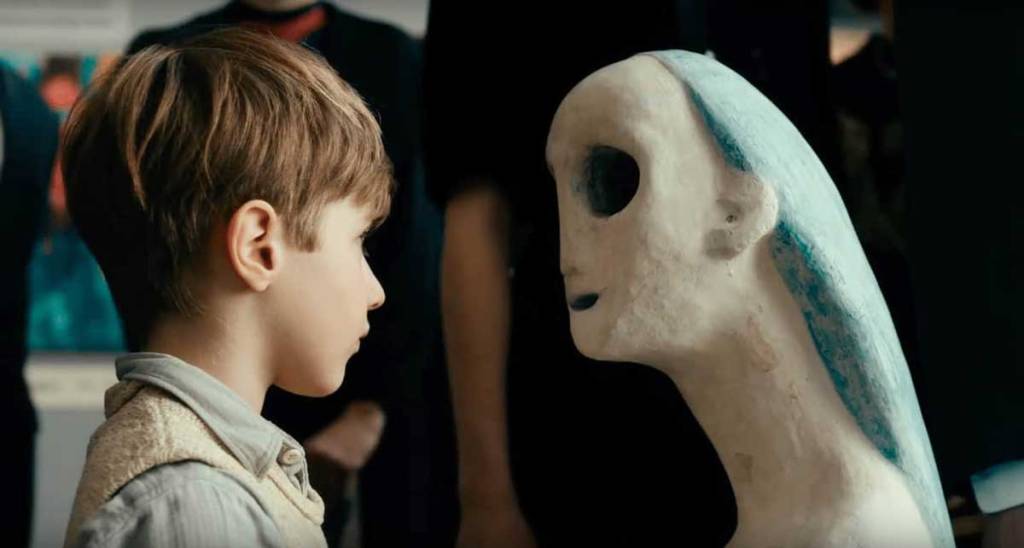
Kurt (Cai Cohrs) is a six-year-old being introduced to ‘degenerate’ art by his young free-spirited and fragile aunt Elizabeth (Saskia Rosendahl who I last saw in Lore (2012)). When her erratic behaviour escalates, she is committed to a psychiatric clinic at the start of the Nazi program of forced sterilisation and ‘euthanasia’ of undesirables. She is brought before its appointed district head, Doctor Seeband (Sebastian Koch), whose insistence at being called Herr Professor forewarns us of the strength of his ego and arrogance.
An adult Kurt (Tom Schilling) pursues his love of art at university where he meets and falls for fashion student Ellie (Paula Beer as mesmerising here as she was in Frantz (2016)). This brings him into the world of Seeband who has avoided accountability for his war crimes and is thriving in post-war communist Germany.
I won’t detail any more of the plot as it is a pleasure to watch it unfold. At times it seems to be about art and purpose and the place of those who see the world differently. At others it is a thriller where we hope the villain gets his comeuppance. Ultimately these threads don’t quite pull together into a satisfying conclusion but that is perhaps because the story is based loosely on the life of German painter Gerhard Richter (who labelled the film an ‘abuse and grossly distorting’ of his biography). It may also be an echo of the repeated theme that all that is true is beautiful.
The characters are fully drawn (three hours allows a lot of latitude for that), the acting is excellent, and the production design and camera work are beautiful and unobtrusive. Other than an odd change of tone toward the end – around the time of the stair mopping scene – it’s a masterful work and I walked out feeling emotionally drenched with a heightened appreciation of taste, touch and smell. I felt a little like Elizabeth who, although her character is not on screen for long, seems to embody the zeitgeist of the story – that life with all its vicissitudes is something to be lived.
 fillums