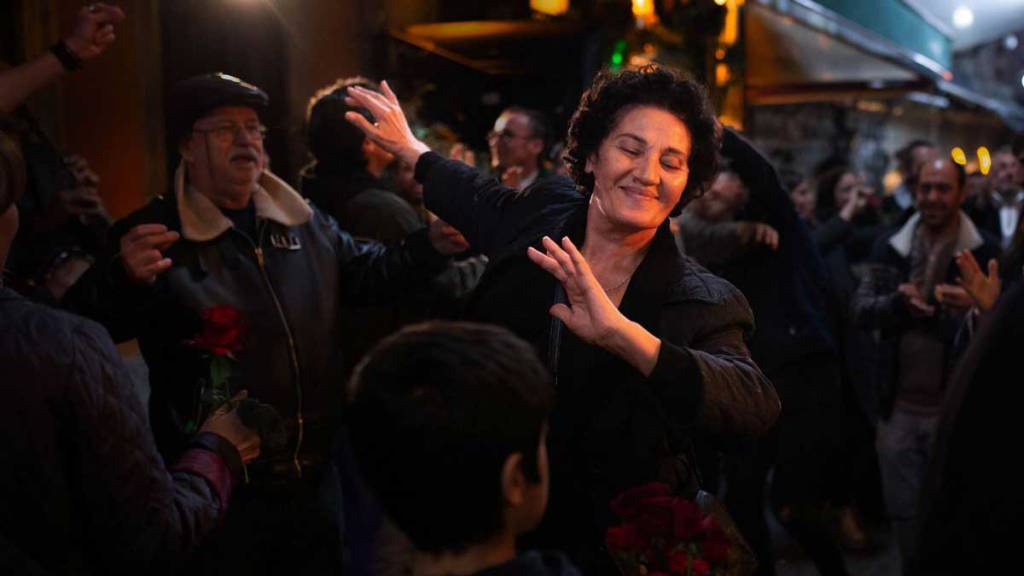

Levan Akin (And Then We Danced (2019)) gives us an engaging story of familial regret and redemption with a glimpse into lives on the margins between country, family and gender.
Lia (Mzia Arabuli), a perennially grouchy, retired, Georgian battleaxe, sets off on a quest to find her estranged transgender niece Tekla. Ostracised by her family for the ‘shame’ of it, she has melted away in the streets of Istanbul. Lia has an accidental companion on her journey to Türkiye, a disaffected young man Achi (Lucas Kanava), who would be a grifter if he wasn’t such an innocent. He is desperate to escape his backwater life, seeing Istanbul as a place of promise.
They are a mismatch – too far apart in generation and values, neither used to having to consider another – but you know what they say, proximity brings understanding. In Istanbul, they are at a disadvantage. Neither are fluent in Turkish or English, they have very little money and they are asking questions in the trans community where their motives are questioned.
We catch a glimpse into the lives of trans women, ordinary people working, sometimes doing sex work, building a family that has nothing to do with blood. We follow the story of one women, Evrim (Deniz Dumanli). She’s a newly minted lawyer, about to get her official female ID papers (and she’s a dead ringer for Dakota Johnson). Life is looking up for her but we see traces of how hard her journey has been.
What I appreciated most about the way this story is told is that Akin avoids being too didactic or sentimental and lets us get to know and appreciate the main characters, avoiding stereotypes. Lia is not all that likeable but as she lets her guard down, we start to see the person hidden behind the walls of generation, tradition and family expectation. It could have hit harder than it does, perhaps aiming for an audience that wants to see the hope not the tragedy, that will only see themselves in Lia if she has some redemption. It feels like a story for non-queer people, showing the transcendence in humility and apology and family over society.
The ending is stylistically a bit artful but I really loved it. It felt like it gave Tekla some agency and found a moment of joy in an essentially sorrowful reality.
 fillums
Pingback: The Substance (2024) | fillums
Pingback: Toll (2023) | fillums
Pingback: All Shall Be Well (2024) | fillums