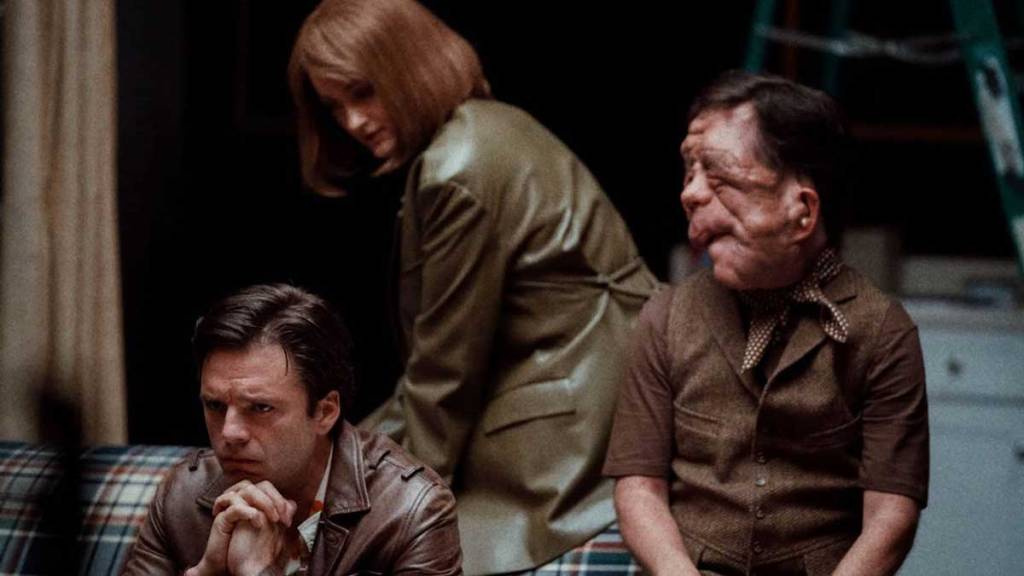

This was not what I was expecting at all. It’s an oddly torturous, funny, thought-provoking story of a man who has significant facial disfigurement.
We see how hard Edward’s (Sebastian Stan) life is, and even when there are people around him who know him really well, it’s hard for him to feel like everyone else. He is super sensitive to other peoples’ regard, to comments he think are aimed at him and, as an actor, tends to get roles in public projects about disability.
Edward has a new neighbour Ingrid (who was played by Renate Reinsve who I just saw the day before in Armand). She is a kind of tall, willowy, charismatic and beautiful stereotypical woman and Edward starts a faltering friendship with her that you can see he would like to be more.
The conundrum of the film comes when he participates in an experimental drug trial that heals his facial disfigurement. He’s quite a handsome man underneath, as he is Sebastian Stan, and he leaves behind his identity as Edward, telling everyone that he is a family friend called Guy and that Edward died.
It’s probably not surprising that this is in many ways of cautionary tale about getting what you wish for. Handsome Edward (or Guy) actually achieves the things that he never thought he could, a girlfriend, a flash big apartment, and a successful job as a real estate agent. This is a riff on some earlier exposition about beautiful people being the ones that succeed in their lives and in their careers as everybody wants to look at them. This is certainly true of Edward/Guy, but of course it’s not. Because what he wants is Ingrid and the opportunity to get to know her again comes when he sees she has written a play about her experience of meeting him and he auditions for the role of Edward.
The story is a bit twisty and turny, occasionally a little bit slapstick, but what we are seeing is Edward descending into his own personal hell when someone else, a British guy called Oswald (Adam Pearson, an actor with facial features similar to Sebastian Stan’s prosthetics), takes over the play, Ingrid and is living the life that Edward actually wanted.
There are some clear messages in there about having the clarity to recognise when you are the one that is getting in your own way. Edward has a victim mentality and is quick to blame others for his unhappiness. Oswald is a man who grasps life with both hands and draws people to him with his enthusiasm and optimism. I initially felt uneasy that this meant that poor treatment of people with disabilities is somehow linked to their own quality of character, but on finding out that Pearson is not wearing prosthetics, I think it is more meta than that. There is definitely some comments being made about unmarginalised people who try and claim marginalisation as a form of entitlement.
You are never quite sure where the narrative is going or what Edward’s story will be and there are a few moments where you think there has been resolution but then the story continues on. You could read into the ending that there is a small amount of reprieve and redemption for Edward although really I think it is saying that we all get the endings that we deserve.
 fillums
Pingback: The Substance (2024) | fillums