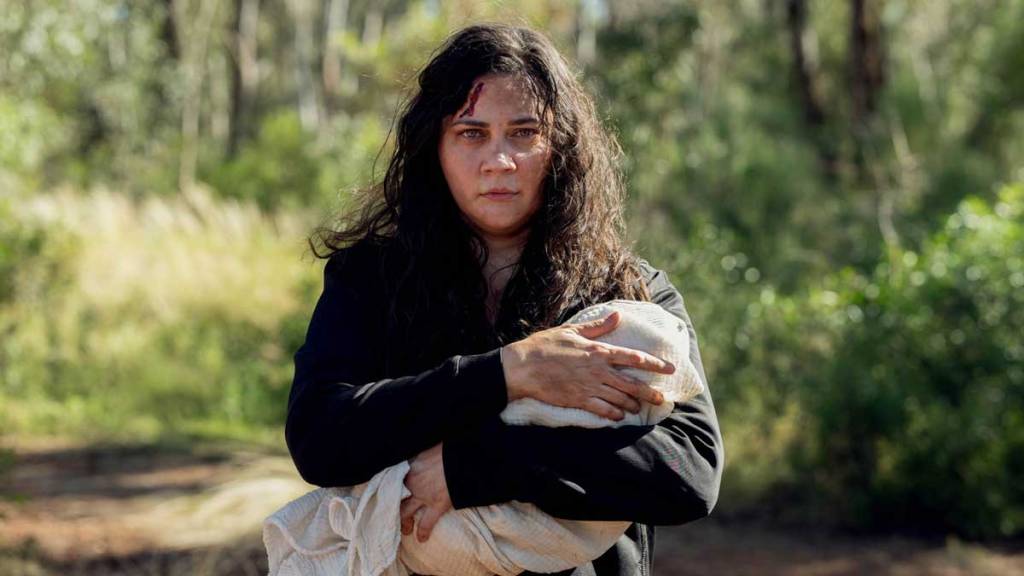

Director Jon Bell has expanded his award-winning short film of the same name into a feature horror that enjoyably blends horror tropes with Indigenous history.
The film makes it allegorical nature clear by starting off with a title card about the Stolen Generations, the Australian Government’s policy of removing Aboriginal children from their families over the best part of the last century. We see it in action in the 70s where two government representatives come to an Aboriginal Mission and all the children run and hide. One little girl, Agnes, hides in a cave and her sister, Ruth isn’t able to save her. We are not sure whether she has been taken by the government or by the Moogai, a malicious spirit who steals children.
Fast forward more than 50 years and we see Ruth‘s (Tessa Rose) daughter Sarah (Shari Sebbens) with her own family. She is another version of the Stolen Generation, given up by her mum (perhaps) and raised by a white family. She is not at all in touch with her Aboriginal culture and is resentful of Ruth’s intrusion into her life in her adult years.
Sarah gives birth to baby Jacob and, in a riff on postnatal depression, can’t sleep and starts to see spooky things happening around the house. She’s not believed, even by husband Fergus (Meyne Wyatt), and is quickly pigeon-holed by well-meaning and not so well-meaning white professionals around her as a delinquent mother. There are some scenes that might be uncomfortable for non-Indigenous people and easily dismissed as exaggerations – the school teacher suspecting alcoholism, the work friend (played by Bella Heathcote) throwing her under the bus – but I suspect they are commonplace even today.
The horror of course is the Moogai and Sarah‘s rejection of her culture means that she pushes away Ruth’s offered protections, the embrace of culture that will give her strength and safety (such a great metaphor for the healing of intergenerational trauma).
It’s a decent film, very watchable, sometimes scary and with an ending that felt incredibly empowering. I got the feeling it was made for a non-Australian audience, definitely for a white audience, as it has more exposition than I felt it needed in order to make sure we understand the nuances. I felt like it could have lent into the suspense and dark horror a little bit more. There is some great imagery whenever the Moogai or one of the spooky white eyed children is shown, but I wanted more of this and more suspense as to the nature of the horror. It doesn’t have the dark heft of The Babadook.
It has one of the most satisfying endings of a horror film that I have seen, and I think particularly because I have felt a dearth of powerful women stories at MIFF this year. Seeing Sarah and Ruth vanquish their demons through culture was incredibly moving.
 fillums