
I sat in the front row of the Capital cinema for the first time to watch this intensely emotional epic from Agnieszka Holland as a man across the aisle from me was chewing on something that sounded like a hard lolly with his mouth open for the first 10 minutes of the film and I couldn’t handle it. The front row was a good choice as it enveloped me in the austerity and complexity of this story of asylum seekers in Europe.
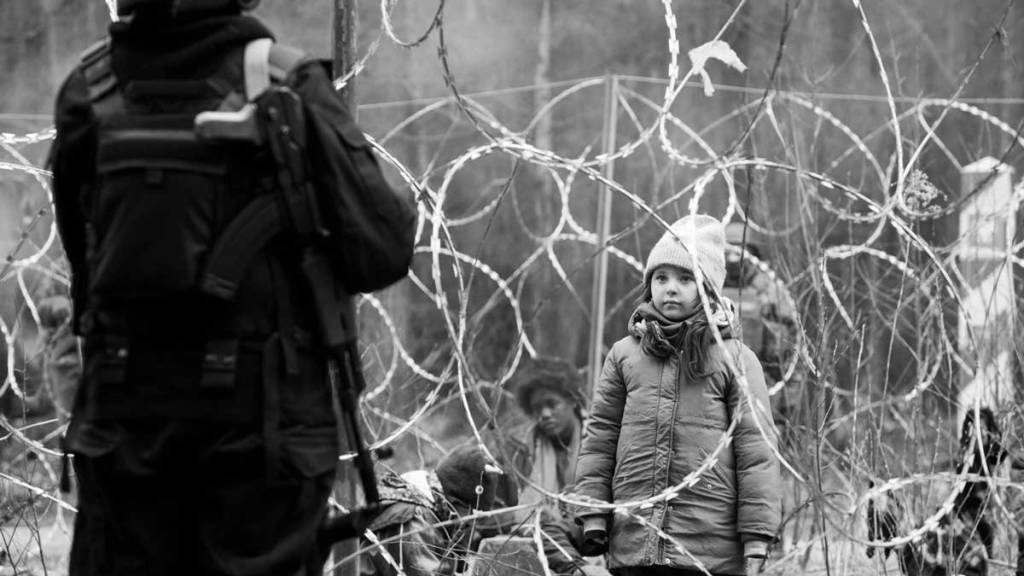
The opening short of a green forest dissolves to black-and-white as the title, Green Border comes up and it feels like we are stepping into some other world, maybe Second World War Poland with razor wire fences and guards and torches in the forest. But it is modern day, and we are on the border of Poland and Belarus, a very significant border when it comes to the plight of refugees.
A ‘green border’ is a weakly protected section of a national border. What I didn’t realise was that Belarus acts as a channel for refugees, mainly to exacerbate its relationship with Poland. The refugees make it to the border and think they have safe passage and then are shoved through the barbed wire and told to run for it. We see this happening with a family, Bashir (Jalal Altawil) and Amina (Dalia Naous) and their three children and grandfather (Al Rashi Mohamad), and an Afghan woman Leïla (Behi Djanati Atai) who tags along with them. They all think it is going to be an easy transition and so are completely unprepared for being dumped in a forest at night.
What they don’t realise is that, although they have reached the European Union and Poland and so therefore have the right to request asylum, the Polish border guards have been told to just throw them back over the border where the Belarus guards will do the same again. There is a scene where the border guard captain is telling his subordinates that these aren’t humans, that even though they have children, they have stolen the children just to get across the border and be able to act as terrorists. It was so chilling as it is exactly the same tactic that was used by Peter Dutton last week when he said we shouldn’t let Palestinian refugees into Australia as they are all Hamas terrorists. It seems that this is done only when the people seeking asylum are black or brown.
Holland splits the story into chapters that intersect. We see the asylum seekers, and the brutality of the border guards is stomach churning and incredibly hard to watch. We see from the point of view of one of the bodyguards, Jan (Tomasz Wlosok), whose wife is about to have a baby and he seems torn between his sense of duty to his country and reconciling his feelings of being a father while watching children treated like animals. We also see a group of activists who provide food and first aid and warm clothes and sleeping bags to the people on the Polish side of the border but can’t do anything else to help them, for fear of being arrested themselves and their own organisation being shut down.
Because we know the situation is so precarious, it is like watching a thriller where you don’t know what is going to happen and who will survive. You can feel the simmering rage, in both the asylum seekers and the activists, perhaps even in Jan. You can see the rationalisations from the Polish people as to why it’s okay or why they can’t help and then understand that this is something that probably most of us are doing.
It’s tragic, but Holland gives us some moments of deep empathy and hope by showing the helpers, the small kindnesses, and the people who choose to look the other way at critical moments. There is a beautiful scene of three African, perhaps Congolese, teenagers bonding with some Polish teens over music.
The ending leaves no room for doubt as to its messaging and deep criticism of Poland’s government and fundamentally racist policies. I won’t give spoilers but the pets say it all. There’s a haunting cello or contrabass that plays throughout – it reminded me of the repeated motif of the Rains of Castamere in Game of Thrones – and it is a sonorous and almost funereal lament that leaves you feeling emotionally spent.
 fillums
Pingback: MIFF 2024 wrap up | fillums