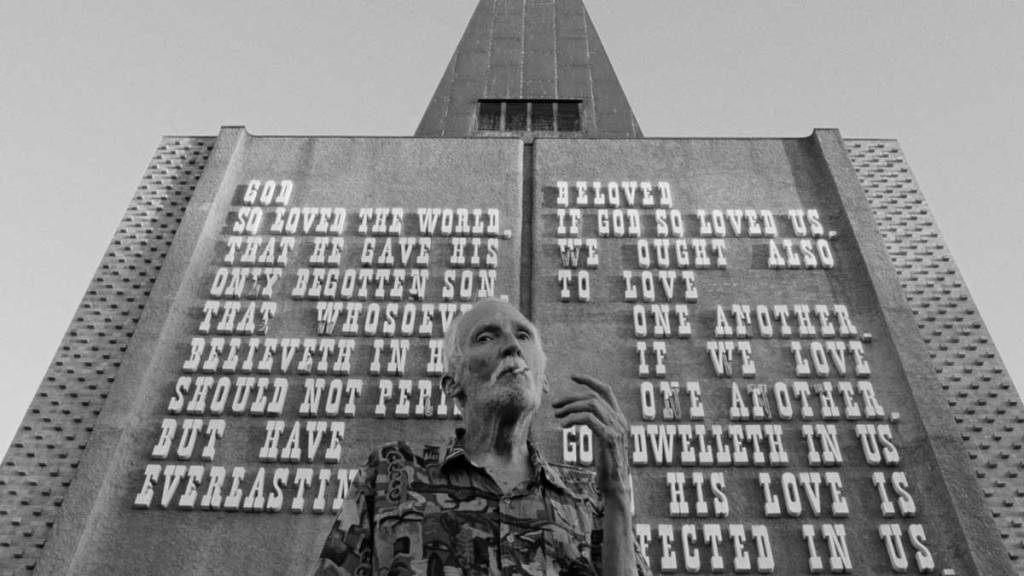

If you like a documentary that is about giving the subjects agency in how their story is told, then Flathead is not for you.
It has a lot to like about it – it’s black and white, it’s about rural Australia, it is observational and takes its time, and it’s two main characters are engaging and worth the screen time.
At face value it’s an interesting slice of life in Bundaberg Queensland, told in a series of vignettes about Cass Cumerford, perhaps in his 70s or 80s, on a road trip back home to Bundy. He’s unwell, a former junkie and happy to tell stories and have a laugh with the people he meets. He’s a bit interested in spirituality, visiting an evangelical church and being baptised. He also visits a healer of indeterminate background who chants and lays magnetised copper coils on him to remove pain.
We also meet Andrew Wong, son of Kent Wong who runs one of those fish and chip shops that have been around for 50 years. Andrew is a bit of a performer, making fitness videos and singing at the drop of a hat. Cass and Andrew meet up and share some moments of spirituality and respect for ancestors.
But this is not really a documentary. At the Q&A afterwards by director Jaydon Martin, Andrew Wong and cinematographer Brodie Poole, Martin answers the question about the mix of fact and fiction, essentially saying as documentaries are manipulated in the edit to tell a story, why not bring that process forward and manipulate it while filming?
It’s a tricky line and a flawed argument, as the answer to that that may well be that you lose the trust of your audience. The movie is essentially scripted but based on a core of truth and with plenty of room for ad-libbing. Martin saw Cumerford’s YouTube videos and thought he’d be a good subject.
Many facts are true – he is ill, his wife did die – but it’s possible that many aren’t. Was he a junkie? Does his son disappear at 17? Who knows. Wong talked about the need to change the script when his dad died, how he was portrayed as an orphan but his mother is alive, just didn’t want anything to do with the film.
I’m pondering how I feel about this. The film’s opening title and credits talk about hard times and labour shortages in rural Australia but this doesn’t really come through in the story. The themes are about about two blokes, about facing death and looking to religion but I don’t feel more enlightened about rural Australia.
As a fictional narrative, it has some interesting moments and the use of music is particularly evocative. The black-and-white is effective in creating other worldliness and giving it some gravitas. The choice of title is about a fish that you can find in the area that is ugly on the outside but delicious, like rural Australia, according to Martin. As someone who lives in rural Australia, it feels like a metropolitan idea.
In fact this whole film feels like a director from the city creating an idea of rural Australia and then giving it the trappings of fact. It’s easier than spending time in those places and letting the characters create the story. I think of directors Maya Newell (In My Blood it Runs (2019)) and Sal Balharrie and Danielle MacLean (Like My Brother) where the collaborative nature of their documentary filmmaking is a key element. Flathead is the polar opposite.
 fillums