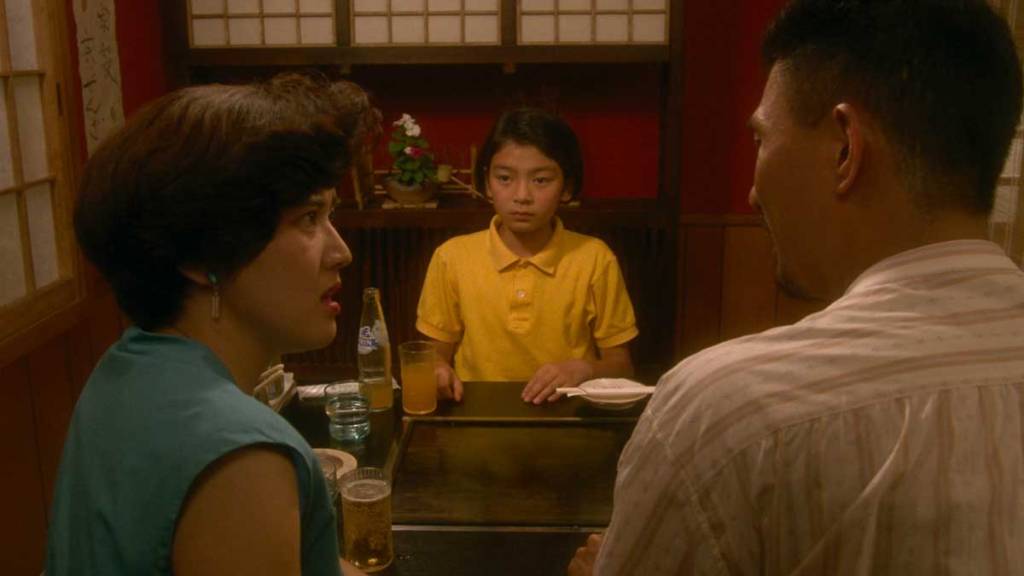

Perhaps my emotional engagement, or struggle with it, with this film about a young girl coming to terms with her parents divorce says something about the distance I have from childhood compared to motherhood.
It’s a 1993 film by Shinji Shômai, who died young at age 53, and it has been restored rather beautifully. Renko (Tomoko Tabata) can’t quite understand why her parents are separating. Her father (H+Kiichi Nakai) moves out of the home and she mulishly won’t accept and tries various tactics to get her parents back together again. These are mostly of the mischievous and mildly bullying kind – haranguing them, punching them, locking herself in a room.
We know that this unlikely to work, but she is so wrapped up in the natural selfishness of youth that she can’t seem to see beyond her own experience. When she tricks her mother (Junko Sakurada) into a holiday on the coast, secretly organising for her father to be there, it understandably all goes awry.
This is where the film breaks into something more poetic (and metaphorical I suspect). The camera work is languid, the shots are lengthy, and we follow Renko as she wanders through a fire festival, traverses a bamboo forest alone at night, meets friendly locals, and eventually has an extended scene where she sees herself and her parents wading in the ocean. The mother in me just couldn’t quite come to terms with the stress of a young child disappearing overnight. I was imagining her mother calling the police and combing the island.
But it feels like a metaphor for her personal transformation. She promises her mother that she will grow up as quickly as possible and then lyrically does so in one night. I think it is supposed to be sweet and poignant, but I found myself feeling the drag. Tabata is astoundingly good as Renko. She is in the centre of just about every frame and there is an incredible naturalism to her performance. Although Renko is not always completely likable, you get a strong sense of her spirit and her resilience and this is due to Tabata’s steadfast gaze and unselfconscious demeanour.
 fillums