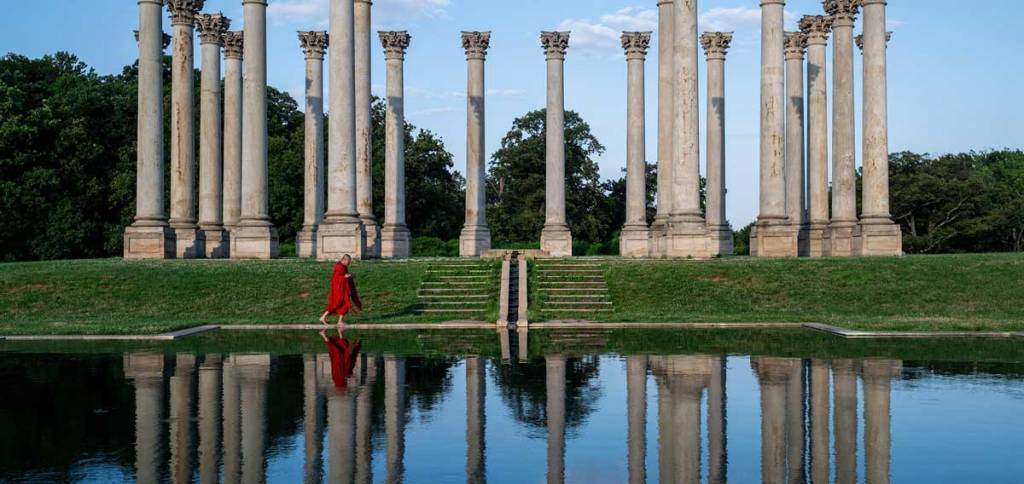

After sitting through four hours of McQueen’s Occupied City, I walked into slow cinema maven Tsai Ming Liang’s 70 minutes of a monk walking slowly.
Slow cinema is an interesting thing and often only given big screen space at festivals. Who wants to pay money to see someone walk slowly or eat noodles or look at a statue? Our film literacy is built on edits and pace and narrative arc so why do we want to see life play out in its familiar mundane slowness? All good questions and I was prepared to nap or walk out if it all seemed too pointless. I stayed though and the packed cinema was quiet and transfixed.
The film has two components – a red robed monk takes very slow controlled steps in a succession of rural and urban landscapes and a young Asian man wanders wordlessly through some of the same spaces. At first, the rushing river and verdant forest seem like China or Vietnam or somewhere remote, but then we are watching the monk walk along the reflecting pool in Washington DC and through Union Station and the Smithsonian and we know we are in the US.
There’s a lot of time to ponder the scene. The red robes against blue and green and grey, passers by ignoring, the monk’s silhouette and shadow. It’s often transcendentally beautiful. The young man cooks and eat Ramen with the afternoon sun glinting through the noodles.
I did nap a bit. It’s like a deep meditation where you drift away and back into the same calm space. My MIFF buddy Mike said the director said he thinks it’s an honour if people fall asleep in his films as they are in a safe in his slow pace. They will wake up oriented. It’s true.
I’m not sure what the meaning is but it feels like performance art with audience participation. Heart slowed, taking time, not thinking ahead to guess the ending. It felt like a meditation on the solitary nature of living, the prayer intonation at the end perhaps saying that enlightenment can only be done alone and at a singular pace. The young man similarly has a solitary life, maybe as a migrant in a strange city, visiting the Smithsonian to see Art from his own country. The relics that move slowest of all.
 fillums