
If you’ve seen The Intouchables (2011) or The Extraordinary (2020), you’ll know that co-directors Olivier Nakache and Eric Tolenado have a deft hand at giving us emotional, character-driven stories that also tackle important social issues.
With A Difficult Year, they have taken a lighter approach to give us something that plays with comedy and romance while skittering over the surface of some real issues of our time.
Our two protagonists, Albert (Pio Marmaï) and Bruno (Jonathan Cohen), are strangers to each other but they are both men who have sunk themselves deep into debt and don’t really have any way of getting out of it. The intro to the film shows French leaders year after year going back into the 70s announcing how “this year is going to be a difficult year” so perhaps we are to understand that these two men have good intentions but are victims of an economic crisis.
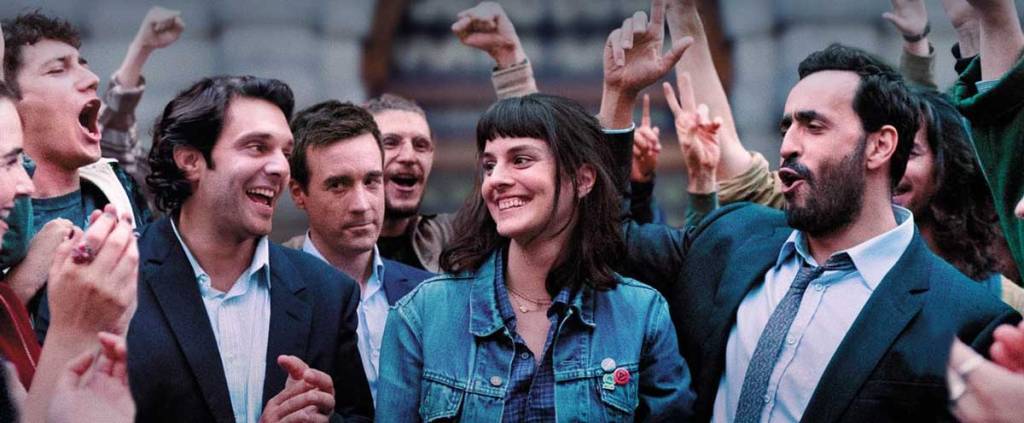
Albert works at the airport handling luggage and has a good line in confiscated goods that he sells on the streets. He has a backpack and a suitcase like a tourist and sleeps overnight, camouflaged amongst all the other travellers. Answering an eBay ad from Bruno to purchase a TV for him at a Black Friday sale, Albert is confronted by a group of climate activists, led by the enigmatic and passionate Cactus (Noémie Merlant).
Albert has no time for them – when you are struggling just to survive on the streets, rallying against consumerism must seem like triviality. He buys the TV for Bruno but when he goes to deliver it, he finds that Bruno’s life has fallen apart and he is there as he tries to end his life.
This throws them together into a workshop by financial guru Henri (Mathieu Almaric) who gives them ‘helpful’ tips like not shopping at the supermarket when you’re hungry and questioning whether you really need something before you buy it. A more practical strategy that Bruno discovers are the socialist meetings where you get free food and drink in exchange for listening to impassioned speeches (or rather you’re able to donate what you could pay which for Bruno and Albert means nothing). This throws them in to the orbit of the climate action group and, we suspect almost against their better judgement or will, they start to get swept up into their enthusiasm for a better world and enveloped in a sense of community and purpose.
Although it is a comedy, and there are definitely light scenes, the story is about something fairly deep but we don’t ever feel like it really gets under the skin of the main characters. Merlant is as captivating as usual and it felt like the screen lit up whenever she was on it. It’s a fun story and I wonder if it will get negative reviews from those who feel that climate change is not a real thing. It doesn’t really delve into this topic particularly deeply, just showing it as something that has galvanised young people to change the world for the better.
It builds to a nice dramatic third act and then somehow lets us down with a twee ending that focuses too much on the romance. By this point I was in great admiration of Cactus’s determination to not get into a relationship until the world is in a better place and it felt like a stance that said her character/female leads are more than just a romantic interest.
It also definitely casts Albert as a lovable rogue rather than a soulless charlatan which I suppose is what is to be expected from a comedy but I felt let down.
 fillums