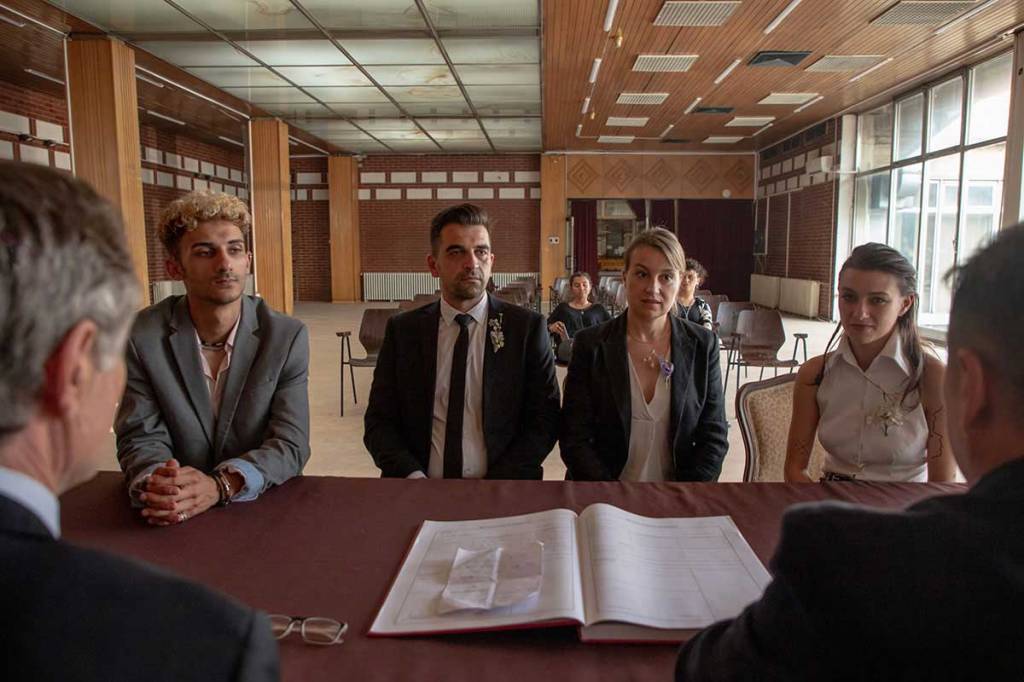

Goran Stolevski drops us into a maelstrom of a household and holds us there through grief and hardship and transcendent moments of love.
At first it’s hard to place each person in this chaotic home in Skopje as this isn’t a nuclear family. It seems the two grown-ups, Dita (Anamaria Marinca) and Toni (Vladimir Tintor) are long-term friends and, as winsome urchin Mia (Dzada Selim) says, Dita likes girls and Toni likes boys.
Dita‘s partner Suada (Alina Serban) is a package deal with her two daughters Mia and belligerent teen Vanesa (Mia Mustafi). Toni has hooked up with gawky youngster Ali (Samson Selim) and soon he is part of the family with a handful of other queer strays. Dita and Toni have thankless jobs while the others smoke, drink, sing, and play dress ups with Mia in a busy, rambunctious style.
All is not well though and an early death of one of the family forces Dita and eventually Toni to make choices. The context of their vulnerabilities are slowly revealed – Ali is Roma, treated as stupid or criminal from a young age. Dita and Toni are gay, something that is hidden from their work colleagues, friends and family. And Vanesa in her grief and rage is like a bomb dropped into their midst.
It’s an often claustrophobic film with its close-up, domestic, swirling camera but in a way that makes you feel the emotion and turbulence wash over and through you. Whenever the story moves outside the home there is tension – from Roma sex traffickers to middle-class coworkers at a dinner party. There are small scatterings of underplayed humour, and I sat through the closing credits feeling suffused with a slightly forlorn but warm emotion. I even forgave the self-conscious and unnecessary final three seconds.
 fillums