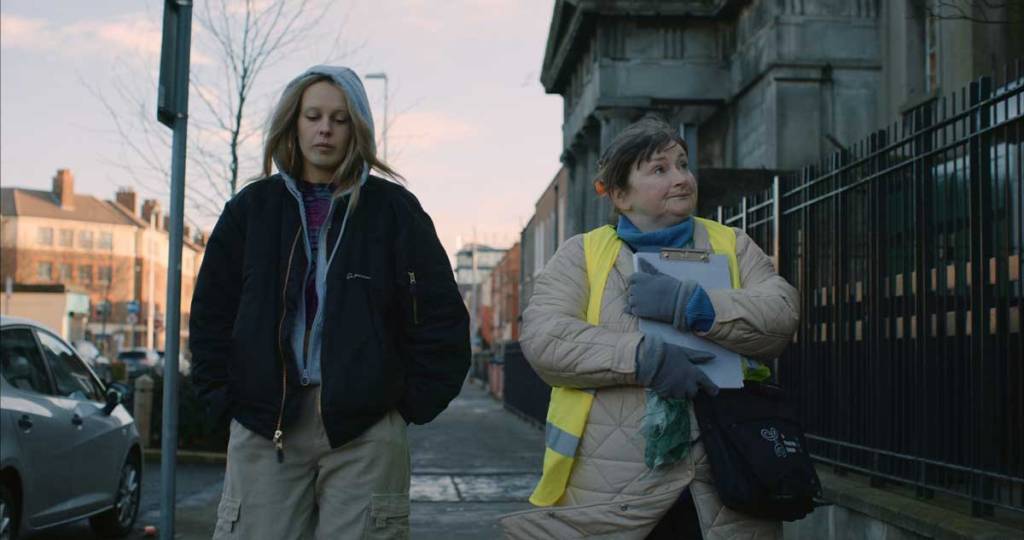

This is a lovely story about friendships that can form across class divides and provide safety and salvation for women experiencing coercive control.
An explanation like that makes the film seem heavier than it is. This is a warmhearted story about Marian (Geraldine McAlinden), a woman in her 60s who has retired but is looking for something more. Marian has had a comfortable life with nerdy husband Nigel (Michael James Ford) who prefers to spend time re-creating battle scenes in miniature then having any meaningful conversation with his wife.
He’s an amiable man but we can see the tendrils of control as he diminishes anything that gives Marian independence, checking who is phoning her, taking control of the finances because ‘he’s much better at that.’ When Marian takes a job as a census enumerator – the person who goes door to door handing out census forms and then collecting them – he is derisive but she persists, choosing an area where no one else wants to go the north of inner city Dublin so that nobody knows what she is doing.
She is a fish out of water in this low socio-economic area and experiences slammed doors, insults and aggression. She forms a connection with mouthy Jewel (Maya O’Shea), a spiky and confident young woman who might possibly be only 16 but seems to be living alone and working in the sex industry, both on the street and out of her home.
It’s an odd pairing, Marian has the gumption to insist that Jewel help her get her foot in the door with her census work and for Jewel, Marian is perhaps the only person in her life who doesn’t seem to look down on her or try to exploit her. She is perhaps also the mother figure that Jewel lost at the age of 12 when her mother walked out.
It’s interesting how Kelly depicts sex work and in general it is positive, although ultimately coded as something essentially dangerous for women. At least Jewel gets the opportunity to talk about why she does it, why she likes it and why it is a positive choice.
Director Patricia Kelly, who once worked as a census enumerator, shot the film in 15 days on a low budget, using a small camera and natural light to give us a feeling of nimbleness and authenticity. What she does really well is let the relationship between Marian and Jewel develop in a way that feels real, slowly revealing to each other, and to us, their experiences of the past, the ways they have been hurt, and their hopes for the future. You can’t help but feel included in their tentative friendship and what it says about the sisterhood of women.
 fillums