
A ad for an anniversary screening of Wim Wenders’ Paris Texas played before the session of his latest film Perfect Days. I lived in London for a few years in my early 20s and it’s where I discovered non-mainstream films. I would go to art house cinemas, particularly one in Soho, and watch films on my own. This is where I discovered films like Paris Texas, Diva, Betty Blue, Down by Law, I’ve Heard the Mermaids Singing and The Kiss of the Spiderwoman. I fell in love with cinema.
Paris Texas had a particular place in my heart, I think mostly for the transcendent Ry Cooder soundtrack – an excellent example of how a soundtrack can elevate a film – and also the slow, spare storytelling that gives you time and space to understand your own place within the narrative.
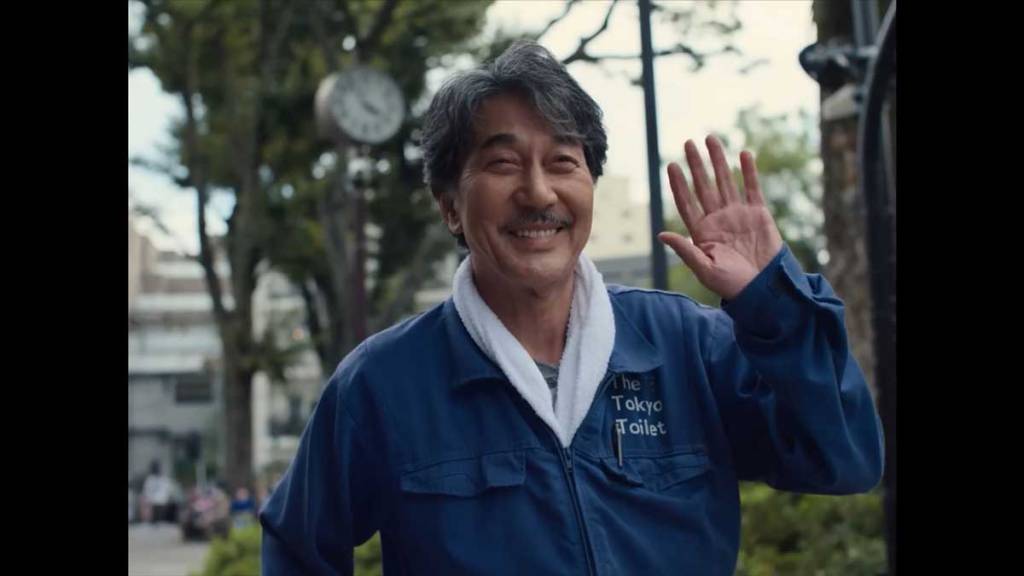
Perfect Days has some similarities. For two hours we are immersed in the life of Hirayama (Kôji Yakusho), a middle-aged man living on his own and working as a toilet cleaner in Tokyo. His life is so solitary that it is a long time before we hear him speak.
What is significant is his singleminded application to each moment in his day. This includes his job – meticulously scrubbing toilets, using an angled mirror to make sure each nook and cranny is spotless – and in momentary breaks, looking up with joy at the sunlight through leaves. The end credits tell us this is komorebi, literally ’sunlight leaking through trees’ and an appreciation of the beauty and wonder of dappled light.
Hirayama is an enigma to his workmate Takashi (Tokio Emoto), who is young and gauche and always talking. Always with a scheme to impress a girl, Aya (Aoi Yamada), who is more impressed by Hirayama’s vintage cassette collection
The cassettes that Hirayama plays as he drives become the soundtrack of this film, mostly music from the 60s and 70s – Lou Reed, Patty Smith, the Rolling Stones, the Animals. Mostly American music, it works to stitch familiarity into the never-ending Tokyo streets. His love of music of the past also connects to his sense of service to the community, something that seems to be becoming outdated.
And the toilets! Tokyo has some amazing toilets. There are domes, cylinders and illuminated glass boxes in a variety of colours that turn opaque when in use.
There are some small narrative threads, Aya’s fascination with Patty Smith, his niece Niko (Arisa Nagano) who turns up unannounced and accompanies on him on his jobs, videoing him in what must seem like such a menial existence.
Mostly though we see the repetition of days, reading at night, greeting the new day with a smile, getting his coffee from a vending machine, visiting the same bars and street restaurants before reading his book again and falling asleep. He has a film camera with him and seems only to take photos of those moments of komorebi, perhaps trying to pin down an ephemeral joy that is then sorted into boxes and labelled with years and months.
I left the film with a slower heartbeat, and a propensity to look up at the trees.
 fillums