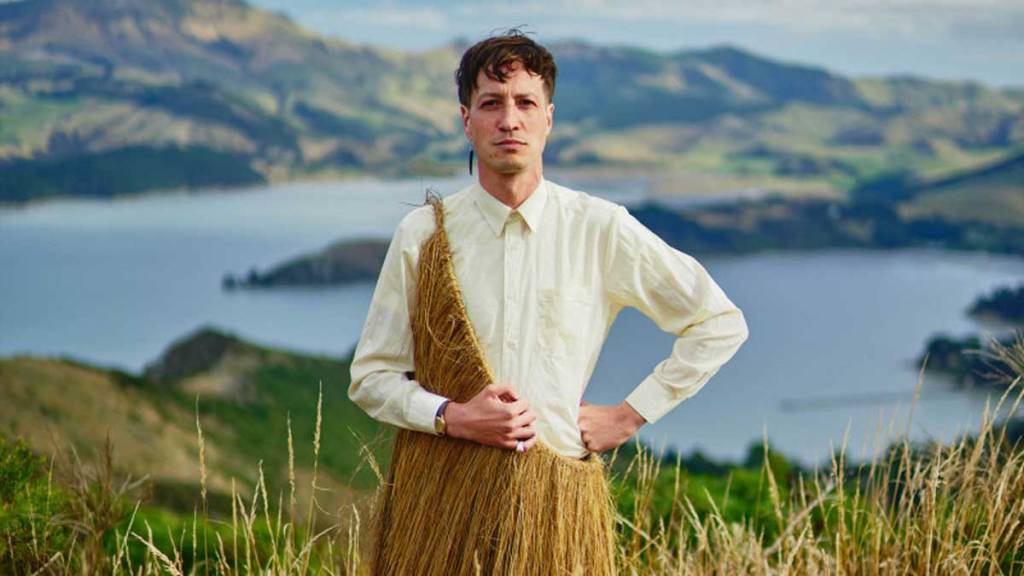

I keep forgetting one of the joys of MIFF is seeing an Antipodean documentary about a person, having them there at the screening and finding out they’re a really decent person. The MIFF trifecta.
I was hanging out in the foyer before the film started and kept noticing a gangly man in a fluoro orange jacket seeming to be at the centre of attention. It took longer than it should to realise it was Marlon Williams. I stood watching audience members come through the front door and the expression on their face shift as they realised the subject of the film was hanging out with them.
I didn’t realise I knew who Marlon Williams was other than an exquisite song he sings with Lorde on his recent Te Reo Māori (language) album (which you should listen to) – Kāhore He Manu E. Director Ursula Williams, no relation, followed the Kiwi artist for four years as he made the album and fills in some of the blanks at the start. He has performed all over the world, including high profile events. It is while playing at the Troubadour in LA that Bradley Cooper in the audience sees him perform and chooses him for a role as himself in A Star is Born, impressed by his Roy Orbison-like vocals.
As much a presence in the film as his songs is the role of Te Reo Māori in New Zealand and in music. He is someone emerging from the generations where there was an attempt to eradicate Te Reo Māori, and so is not a fluent speaker. He wants to reconnect with the cultures of his mother and father, and in particular his father who lost all connection to his language.
We see Marlon working with a language expert and good friend Commie, who gently chides him over his pronunciation and helps him craft his songs in a way that sounds natural. Williams lets the music play out as a character in itself, playing songs in their entirety, often cut over various moments and performances.
Marlon is an energetic and positive character, full of large gestures and big smiles and great connections with the other artists around him. You get a sense of him being earnest and dedicated to both music and Māori culture. You could see this in his interactions with the audience in the foyer at my screening and in the Q&A afterwards.
If I had any criticism, it would be that there is an assumption that we know who everyone is in the film. There is no titling of people and so often we see performances with people or Marlon singing or interacting and we have no idea who the person is. I only found out his Te Reo Māori teacher and friend is called Commie in the Q&A afterwards. I can see how this might allow us to just let the story pass through us, responding to the music and emotion rather than intellectually engaging with who the people are, but it meant I felt I wasn’t picking up the nuances of his story and life and music.
 fillums