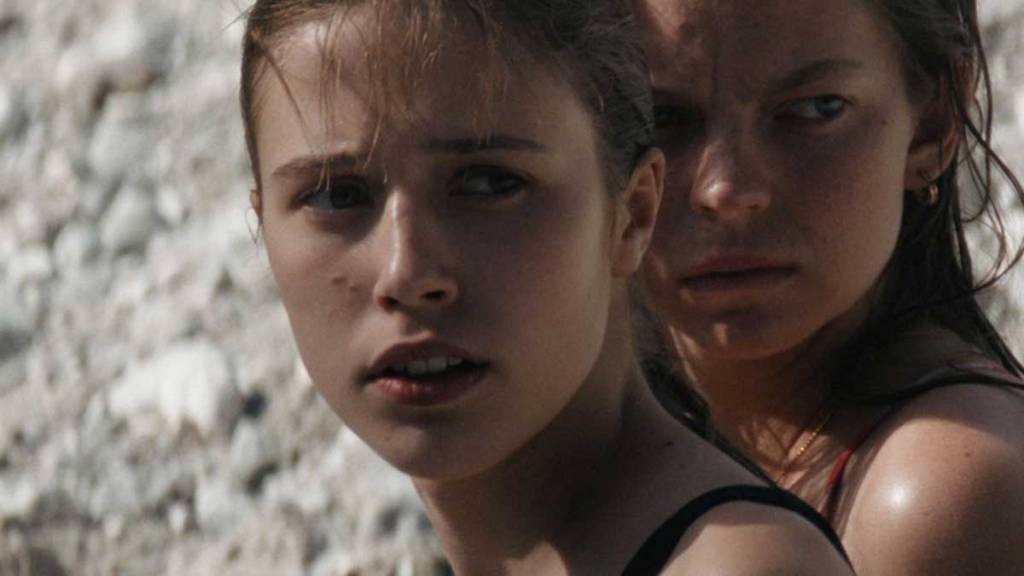

Slovenian director Urska Djukic gives us a convincing meditation on emerging teenage identity and sexuality in a repressive Catholic culture.
I’m not quite sure what I expected from this, I think more choirs and less excruciating shame and desire. I mainly came along to see it because it’s Slovenian and having spent some time in the Soca Valley, I wondered if it would be nostalgic.
The main protagonist is Lucija (Jara Sofija Ostan), who is new to a Catholic convent choir and, at 15 or 16, is juggling the very conservative expectations of her mother with normal adolescent desires and a wish to fit it. The pull of the promises of the ecstatic love of God, something we assume has been encouraged by her mother who seems to infantilise her, seems to be where she has come from. When the choir goes away for three days for intensive rehearsal, she is suddenly dropped into a world where there are male workers bathing naked in the river, shared dormitories with female friends and the sense of the world opening up for her.
Djukic occasionally intercuts the dramatic scenes with images of flowers, symbolic (but not so subtlely) of vulvas and desire and fecundity. The Slovenian title translates more as ‘What’s up, girl’ and seems to be because of a song over the end credits and, as an expression that can be used with empathy or with accusation, I think better captures the double standards we are seeing.
Lucija’s friendship with the more worldly Ana-Marija (Mina Svajger) is the catalyst for her awakening, not always in a good way. There is desire between them, a wish to push boundaries and experience the things that are forbidden and we can see this starts to build Lucija‘s confidence in following what she feels.
The conditioning is strong though, and something that is so hard to watch is how easily the rug can be pulled out from under you in an environment where women’s autonomy is so carefully controlled. It’s not always an easy watch, and I really liked the final sequence which built on the fragmentary surreal touches. It is enigmatic, potentially chilling, and a strong statement about Lucija‘s existential dilemma.
The scene in the bathroom I felt was particularly well handled. I kept waiting for a scene of this ilk, a little bit unsure of how it would be handled but I really loved the framing and the simple devastation of the laughter.
I didn’t think it needed the final scene though. As I exited the cinema, there was a woman desperately looking for someone to talk to about the film and so we chatted as we walked. She had the same concerns as me.
With the mirroring of the grapes with an earlier scene with sour grapes, it felt a little bit too cute, in a film which is definitely not cute. I don’t think we needed it, the rollerblading shot would have been enough for us to feel there was some hope.
 fillums