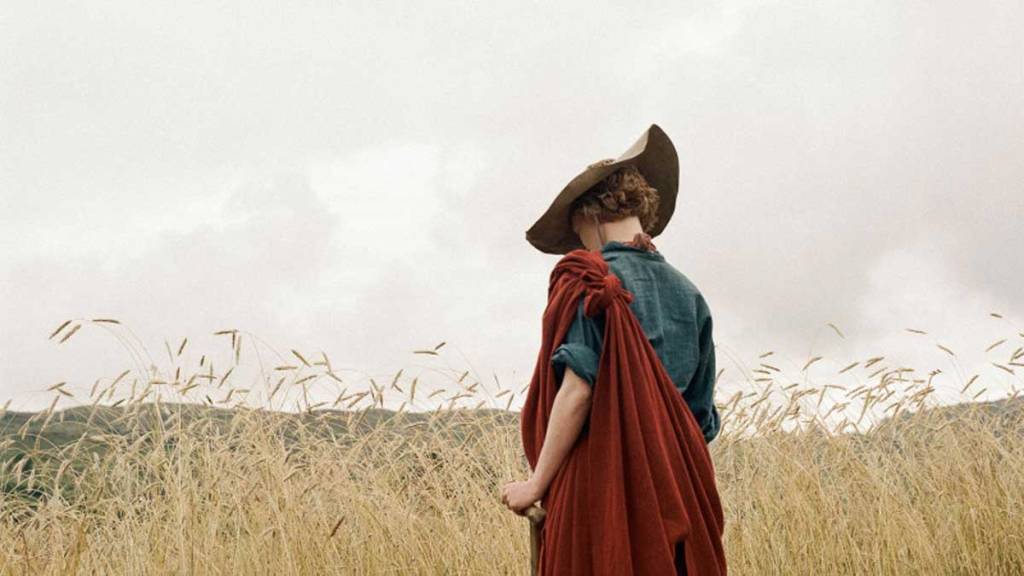

This is such an interesting film by Athina Rachel Tsangari (Chevalier), and something that I appreciated more after hearing her talk in a Q&A afterwards.
It’s a film that feels like it is set in the past in Scotland, at a time where people are subsistence living on the land, growing crops and farming sheep with no goal other than to survive in their villages. We begin the film as the master’s barn is burnt to the ground, and it is the catalyst for a series of events that sees the future of the village at risk.
Our main protagonist is Walt (Caleb Landry Jones), who is something of a wild man. He is not a local to the village, he has arrived with Master Kent (Harry Melling) as his friend, and although he lives with the villagers, he isn’t really accepted as one of them. It is that uneasy space between authority and the people where you are never quite accepted as either. There are clear divisions between insiders and outsiders (and was there a hidden love story that is very underplayed?).
What we see unfolding is a kind of representation of the land clearances in Scotland in the 18th and 19th centuries but really it could represent any country or period where progress has taken land and livelihood away from the many. Although it is clearly set in the past, it is almost like a parallel universe where Tsangari has taken the concept of being authentic to the location and the time and worked within these constraints, without necessarily trying to be true to a literal past. Think costuming that is all natural fibres and dyes, crops that are heirloom grains of barley, rye and flax, and old breeds of sheep. And there are a few odd contemporary touches, like some of the language used, the outfits of the thugs feeling a bit gestapo-like, and electronic music mixing in with traditional tunes.
Hearing Tsangari speak afterwards, she talked about this as a deliberate technique she has, to take a genre and then to destroy it. It makes for slightly uncomfortable viewing, but there is something about it, something about the anarchy and the refusal to be wed to a past written history that I really like. It’s not necessarily evident to the viewer though.
It’s a fairly bleak story, and no one really is the hero. As Tsangari said afterwards, they are either seduced by progress or passively consuming it and sitting by while it happens. She feels that we are often like this, even us as an audience, consuming news about Gaza or Ukraine or world disasters and scrolling on.
There is something about the muddy, Scottish Highland life that sinks into you as you watch. Landry Jones is good in his part as he is sympathetic but not fully likable. I kept getting distressed that his cloak was always dragging on the ground which didn’t seem like something that would be of benefit to anyone.
It has a little bit of the surreal feel of some other films of Tsangari’s, and her compatriot Yorgos Lanthimos, where are you are in a world that seems real but something is slightly off-kilter. Although this often makes for an uncomfortable experience, I think it forces us out of our comfort zone to look at our past and present differently.
 fillums