
At the end of a long day of film watching, when you’re feeling a little bit tired emotionally wrung out by a couple of films, what you need is something a bit silly, a bit lovely and with a few twists and turns you don’t see coming.
This is the first feature written and directed by Ratchapoom Boonbunchachoke, and it was chosen for the MIFF Bright Horizons program (for first and second feature films). It is set in an other-worldly Thailand where we first watch a mural depicting heroes of the past being made, and then skip forward to present day where it is being replaced by a shopping mall. Progress destroying the people perhaps.
The only person who seems to have noticed the mural is Academic Ladyboy (Wisarun Homhuan), a bit of a loner, we feel, who is upset by the amount of dust coming into her apartment. This necessitates a trip to a vacuum cleaner shop where she buys a decent model that seems to do the job. When she is woken in the night by coughing, she realises that the vacuum cleaner is malfunctioning and letting go of all the dust it has collected during the day. A call to the company produces a repair man, Krong (Wanlop Rungkumjad), who arrives unusually quickly.
Krong is a handsome, blue haired young man who provides sympathy and conversation to Academic Ladyboy and then launches into a long story about the factory the vacuum cleaner has come from. It is haunted by the ghost of a worker who died unfairly.
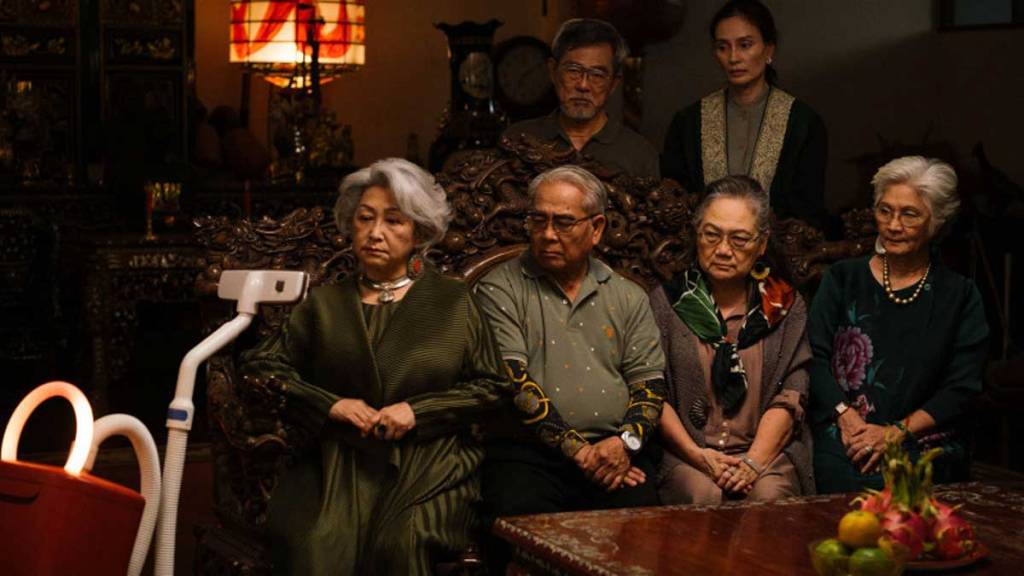
For most of the film we follow this story, which is about factory owner Suman (Apasiri Nitibhon), who has been left the factory after a husband died, her son March (Wisarut Himmarat) who is in deep mourning for his wife Nat (Davika Hoorne) who died of a respiratory illness and the ghost of Tok (Krittin Thongmai), the worker who is terrorising the factory. It is a story of unfinished business, abuse of class, and of being complicit in order to maintain progress and power. It was a good one to watch after Harvest, which also deals with our complicity when we stand by and watch things destroyed (and as a delightful anecdote, Harvest director Athina Rachel Tsangari was sitting in the row behind me during the screening).
The film is stagey and stylised, often funny, full of unexpected humour and twist and turns, and never seeming to take itself too seriously. We get caught up in the story of ghosts inhabiting vacuum cleaners and the difficulty of letting go of memory. It is clearly an allegory for the way things are torn down by government and history has changed. The way ordinary people are erased and wealthy and powerful people just keep getting more.
It dragged a little bit towards the end, maybe that was because it was pretty late at night, but this allowed us to witness a bit more of the emotional repercussions of what was happening. Boonbunchachoke gave a lovely Q&A afterwards and seemed surprised to find that his film was doing so well. He explained that the dust metaphor is something that can be understood better by Thai people as calling someone dust is a way to say they are subhuman. Knowing this lends a rather chilling aspect to the film, although I don’t think we are supposed to take that too seriously.
 fillums