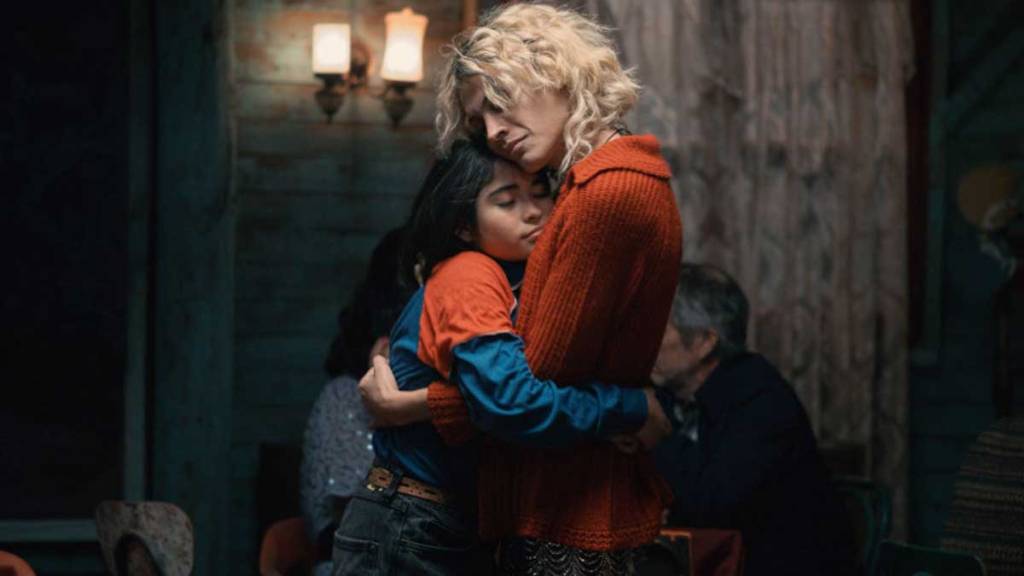

I was sad I could not stay for the Q&A as the introduction by the director, Diego Céspedes, and one of the stars, Sirena Matilde, was heartfelt and drew attention to the film as a story about the beauty of trans and queer families.
We are in Chile in the 1980s but this is a barren, frontier place, like a Western town amidst desolate mountains and grassless plains. The population is made up of miners, the epitome of macho culture, and Madame Boa’s place, where queer and trans performers are the colourful and mysterious heart of the community.
The family of performers, many like Flamingo (Matías Catalán) named by Madame Boa (Paula Dinamarca) after animals, have taken in an orphaned girl Lidia (Tamara Cortes) and raised her like their daughter. She is closest to Flamingo, who she calls mother, a beautiful and faded performer who has a sickness that is spreading across the community.
This film makes no secret about the fact that the illness is an allegory for HIV and AIDS, and with a certain amount of poetry, the plague in this film is transmitted through intense gaze. This introduces some interesting elements, like the miners and townsfolk trying to blindfold the performers in order to save the men from the sickness. There are moments of lightness and hope, and the warmth and strength of Boa’s community is the thing that adds the most richness.
There is no way this is not going to be full of sorrow though, and as it slowly works its way through the story, we get elements of revenge and denial and good intentions. The sense of allegory also seems to fade and be replaced by reality.
Lidia is a solid lead character, a bit of a cipher for what is going on around her. The story really though is about the performers, and it is at its richest when we are focusing on them. It drags a little and by the end, I wasn’t really sure what the cohesive whole was.
 fillums