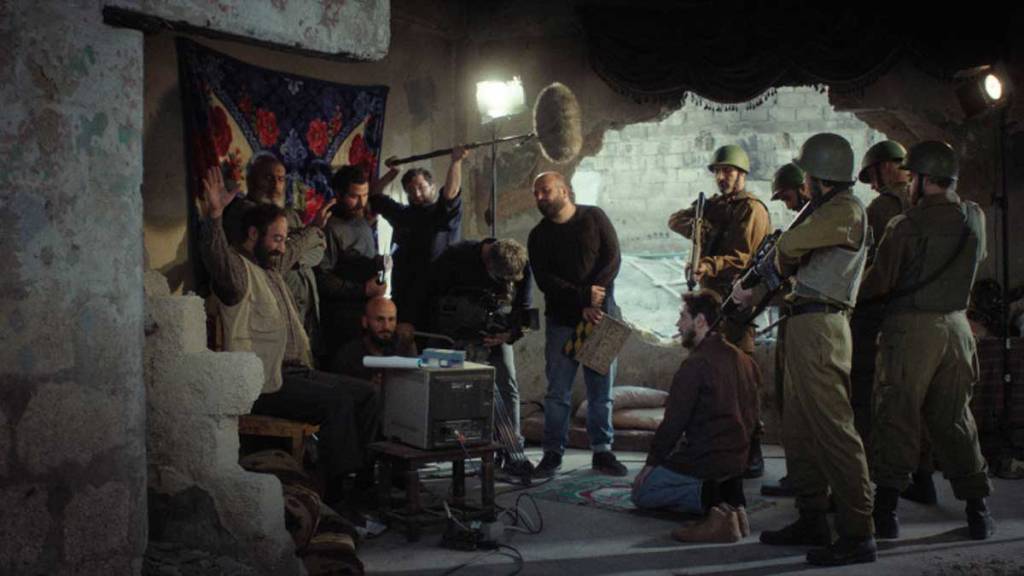

This is a wry and diverting film within a film story, as if set within our daily newsfeeds.
The Nasser brothers, Arab and Tarzan, (Gaza Mon Amour) set this almost Western in Gaza in the 2000s. Osama (Majd Eid) is a falafel shop owner who seems to spend his day wrangling narcotics from doctors and fencing them on the streets. The one actually making the falafel sandwiches is Yahya (Nader Abd Alhay), a rather meek man who does what he’s told, including preparing sandwiches with drugs hidden inside of them.
The black hatted villain is policeman Abou (Ramzi Maqdisi), someone who tries to persuade Osama to give up names of dealers, and when this is not successful, starts to threaten him and make use of his position of power.
You can divide this movie into two halves, the first half exists to set up the characters so that we understand the motivations for the second half. It is structured in a way that we are also watching a film being made within the film about a Palestinian martyr who looks a lot like Yahya. It is sometimes messy, like a gritty soap opera to distract us from the real horror.
Interspersed with the scenes are diagetic glimpses of television and newspaper headlines so that we can see exactly where we are in the occupation of the Palestinian territories. One moment shows the wall being built that will cut Palestinians off from the sea. In the next shot, we see Osama against the wall of his falafel shop painted with palm trees. It is a subtle and stark reminder.
The second half of the film picks up the pace and we see the hero and the villain face each other. We are definitely given a sense of cinematic superficiality to certain aspects of it, partly caused by the fictional filmmaking within it. It works in bringing a certain lightness to the characterisations, making the awful scenes more watchable (and more artificial).
The story is resolved in an unusual way, you won’t see it coming. I quite liked it, because it provides a circular reference to the opening of the film, and I think gives us a commentary on the media we consume and the reality behind it.
Also, there were no women in it.
 fillums