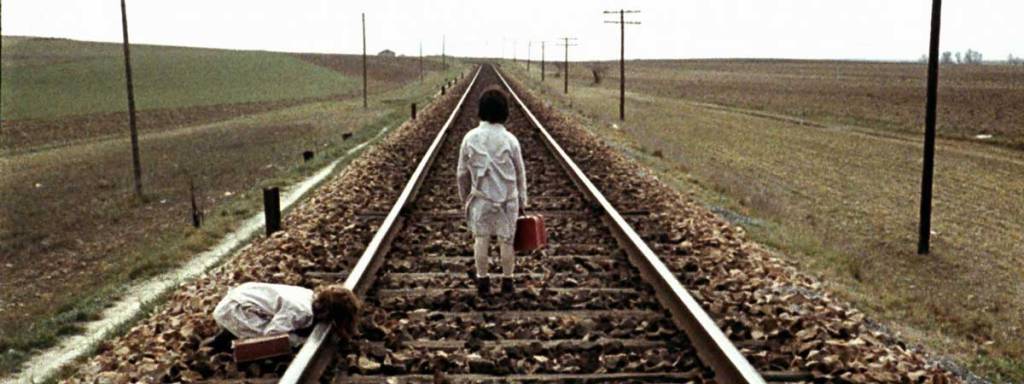
Victor Erice’s classic film about childhood and Spain’s political turmoil is transcendent film making.
This has been one of those films I’ve been long wanting to watch without really knowing anything about it. It’s a simple story told without much dialogue and full of symbolism that you won’t necessarily pick up without some knowledge of Spain in the 1940s and 1970s (I googled it).
1940, when the film is set, marked the end of the Spanish Civil War a year before and the rise of General Franco’s cruel dictatorship that saw many atrocities. 1973, when this film was made, was toward the end of his time in power and when heavily-controlled art-forms like cinema used symbolism and coded messages to speak out against his regime.
The story begins with “once upon a time” and is set in a rural Spanish village of dilapidated and damaged buildings, showing the effects of war. The only bright spot in the villagers’ drab lives is the makeshift cinema that comes to town and we see young sisters Ana (Ana Torrent) and Isabel (Isabel Tellería) watching James Whale’s 1931 Frankenstein with wide eyes. Ana and Isabel live with their parents, beekeeper Fernando (Fernando Fernán Gómez) and Teresa (Teresa Gimpera), in a huge, dark and dilapidated house.
The heart of the story is that watching Frankenstein has awakened in seven-year-old Ana an imagination and awareness of death. She can’t understand why the monster in the film killed the little girl and, although her slightly older sister Isabel pretends to understand, she can’t explain it to her. What she can do is tell Ana about the spirit of the monster that lives in an old stone barn and this sets Ana off on a journey that may harm her.
There are a few visual and narrative elements that are apparent as you are watching the film. There is the reference to beehives, through Fernando’s tending of the hives, to the golden glass that mimics a honeycomb structure and Fernando talking about the chaos of the beehive where activity is senseless and death immaterial. This feeling is carried through to the family who all seem to live separate lives like they are in chambers of the hive. We never see them all in a frame together, Teresa writes letters to an absent loved one, Fernando paces his study, and we get the feeling of a family that is essentially broken.
What impressed me most was the lack of dialogue in many scenes – Erice can relate so much about characters and the story just through visual communication. Ana is mesmerising as the wide-eyed, dour protagonist. She was cast, apparently, because she genuinely still believed in monsters and she spoke later of how seeing the man dressed as Frankenstein’s monster traumatised her. She reminded me of Scout Finch from To Kill a Mockingbird, as much for her look as for her representation of the innocence of youth.
In terms of symbolism, there is a lot of debate about how much Erice was saying about Franco’s dictatorship. The most simplistic metaphor is that Frankenstein’s monster is Franco or his regime but it’s more likely that the critique is broader. Ana’s family represent those who lost the war and Ana will grow up under the dictatorship where death and illusion are her reality.
Regardless of meaning, this is a superb piece of film making that will stay with me.
Have you seen this film? Let me know your thoughts in the comments below.

