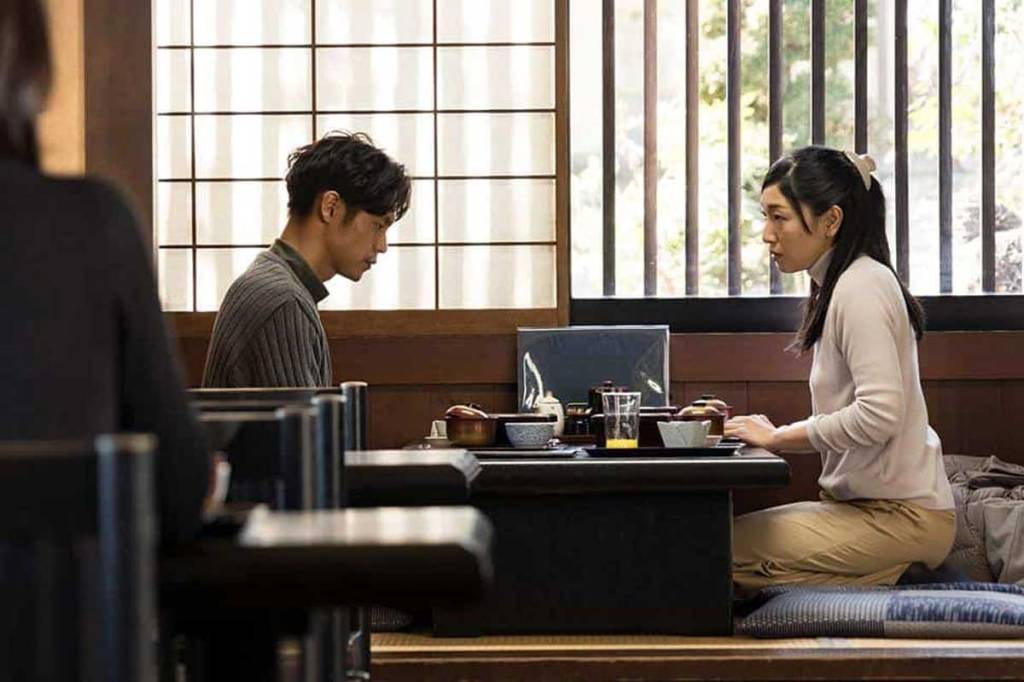

Maybe I shouldn’t have been surprised/disappointed that a film with this title revolved primarily around the experiences of a group of men.
I think the disappointment came because it seems like the story is about a woman Rie (Sakura Andô), recently divorced and living with her young son. She meets a shy man Daisuke (Masataka Kubota), an artist who seems to know how to hold space for her when she talks about the loss of her youngest son.
The first act revolves around her, and how caught she is in her own grief, the perennial disappointment of her mother and the limited opportunities for a divorced woman in Japanese society. The film isn’t really about her, though, it’s about that shy artist who she ends up marrying and having a child with. It’s only after he suffers a tragic accident that we learn he is not who he says he is.
We are given intertwining threads of the lives of several people, adding up to an exploration of identity and acceptance in a conservative culture. Rie employs the help of an old friend, Kido (Satoshi Tsumabuki), a lawyer who sets out to try and unearth who her husband really was.
And that’s where the film really becomes about Kido and his life and sense of identity. He is Korean-born but naturalised Japanese and it is something that keeps being brought to his attention, and not in a good way. We see TV footage of xenophobic riots, and so we understand that, for all his professional success and lovely Japanese wife and life, his sense of inclusion and place within Japanese society is precarious.
I had a really bad seat at the screening, front row to the side, and it meant that everything seemed a bit vertiginous and my neck ached from looking up from the subtitles to read faces. This definitely affected my visual sense of the film as a whole and added to the feeling of the story dragging somewhat. I think on a better day it might’ve felt like a director taking his time to build character and story but I struggled to stay engaged, particularly when the story drifted away from Rie and her son. The film only just passed the Bechdel Test and all of the conversations between women were steeped in stereotypes.
There is something of a twist in the final scene. I am still scratching my head as to what it really meant, and if there was any deeper meaning to it. If it’s what I think it is, it has an awful undertone of female characters as cheap narrative devices.
 fillums