
Oh, I feel conflicted about this documentary. I was going along with it for quite a while, even forgiving some things that didn’t quite make sense – were there no neighbours who could drop in or answer a phone call? – but a growing unease left me feeling cheated.
Spoilers ahead – although I actually think it’s better to know beforehand.
I don’t mind a director who turns the tables – James Benning’s The United States of America (2022) immediately springs to mind but the stakes of authenticity were pretty low and the pay off satisfying. Here, directors Morteza Ahmadvand and Firouzeh Khosrovani present something that seems real, albeit interspersed with the poetic, but essentially hide behind the term documentary in a way that undermines the very real themes of the story.
We are being shown the story of an Iranian woman, Maryam, who was smuggled out of Iran just after the revolution, organised by her parents so that she could have a better life. She is living in America and as her parents age, she feels so dislocated from them that she has surveillance cameras installed in their house so she can watch them all the time.
At face value, this is confronting, although it provoked me to think about if I could have done it with my own parents, if my children could do it for me. The lack of privacy, though, the impact it might have on your day to day and the shift from child to hidden authoritarian.
Overlaid with this silent imagery of the parents is Maryam’s musing on her own experience, her fears and concerns and sense of distance and isolation. Being a parent, and remembering myself as a child and as my parents aged, it is the perhaps inevitable self absorption of the child. We also see super eight film footage, news footage, and some poetic visions of birds and fish trapped and multiplying.
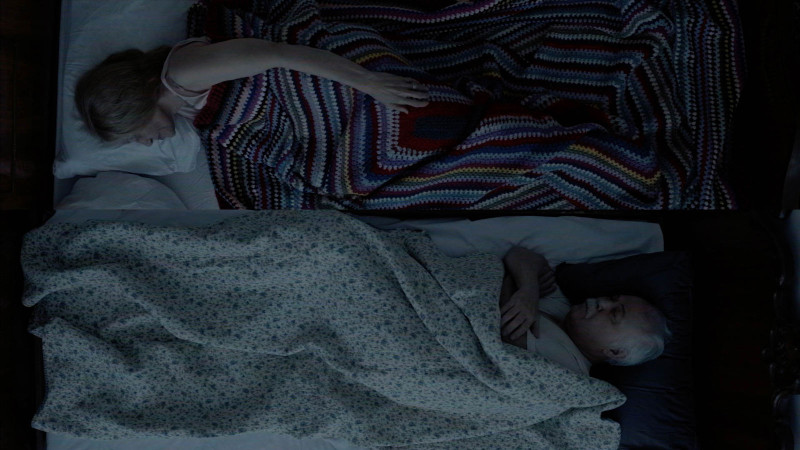
It is beautiful and poignant. And yet. There are some moments of doubt and a point towards the end that jars. You see the surveillance footage of her father and somehow it doesn’t seem quite right. We are brought to a moment where she is obsessively viewing her father who has fallen asleep on the couch and she is worrying that he has died. For eight hours. We are led to think we are watching an intensely personal moment of her father‘s death.
But it seems we have been spun a poetic fiction. In the end credits there is acknowledgement of actors and the penny drops that none of it is real. For a while I had been thinking how fortuitous it was that she had saved all the footage, and also how visually striking some of it was, particularly the footage of her parents beds from above. How gullible I am.
That sudden disappointment undermines a lot that’s good about the film. We are sitting with the universal experience of ageing and generational change as well as understanding the effects of diaspora and separation from family and culture. The concept is interesting and much of the spoken word feels like poetry.
If I knew from the outset that it was interpretive rather than real, it would have still told its story, still pulled me into a meditation on what it is to watch your parents grow old and die. I just wouldn’t have felt so let down. This is not a documentary.


Pingback: Rehearsals for a Revolution (2026) | fillums