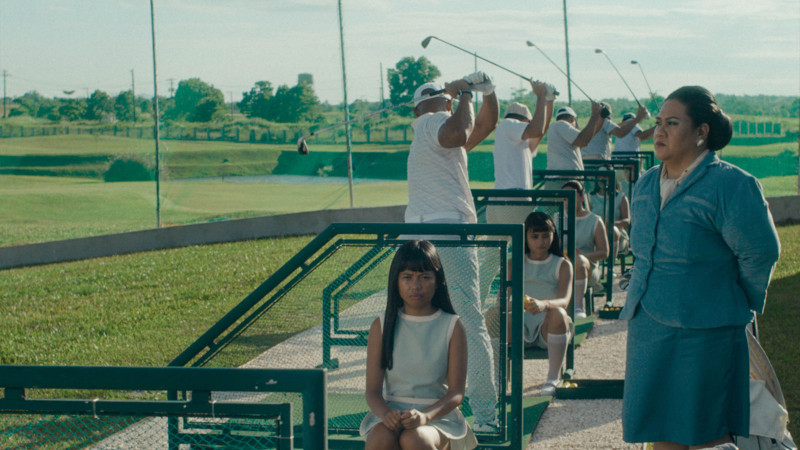

This had the pastel hued satire of Greener Grass (2019) but with the bleak and sobering reality (without the fever dream) of Sweet Dreams (2023).
The first scene of this film is a busy Manila street and a tour bus. It is all noise and chaos and blank-faced Chinese tourists being exhorted to say hello in Filipino – Mabuhay!
And then we are in a sumptuous and other worldly golf resort which becomes the setting for this unsettling narrative. The opening scene is water cascading over greens, and the realisation that during a drought, they will do what is needed to keep the greens lush and the trees alive. If the trees die, they will just replace them with a new one – this might be early foreshadowing of the overall theme.
It is oppressively hot, and ‘tee girl’ Isabel (Jorrybell Agoto) is new to this job and the resort. The tee girls all wear matching uniforms with long white socks and their job is to sit beside each player on the driving range and replace the ball on the tee after each hit. Next up in the hierarchy are the caddy girls, dressed in coral and seeming always cool and serene. The tee girls are not allowed on the golf course and there are obviously a strict rules around who is entitled to enjoy the lush greenness and the, albeit manicured and perverted, nature.
Isabel overhears is the president, Dr Palanca (Teroy Guzman) speaking of her home district and makes a connection with him by speaking their local dialect. He is seemingly patrician and magnanimous, liking the spotlight and one of those leaders who governs by personality and entitlement.
There are some threads of story that wind through, one is a young girl lost on the golf course, the other is Isabel‘s search for Dr Palanca to give him back his golf club. Her search takes her through the different areas of the resort, many empty spaces looking like a past heyday or development in spite of an audience. We feel the oppressiveness of the heat, the coolness of the air-conditioning inside the resort, the excess of food served in the restaurant, and the dissonance between the Filipino workers, the wealthy owners, and the dispassionate Chinese tourists.
Although it takes a while to fully emerge, it feels like we are seeing a metaphor for contemporary Philippines. A place where Chinese wealth is relied upon but American connections are valued more. Where productive farmland is taken away from people and turned into pointless pastimes for the privileged.
I saw the film with a friend (thanks Ana-Rose!) of my eldest daughter, who is Filipino and a history scholar. She gave me additional insight into the significance of the rural area where both Isabel and Dr Palanca come from being the place where the Marcos family originated and where they retreated to in between regimes. She added:
The Philippines has a fascinating and dark colonial history of people ‘collaborating’ with power to protect their families over others, despite class solidarity – so I think the caddies largely represent that! The choice to collaborate with power for your immediate family’s wellbeing instead of fighting against power. The title Filipiñana, it’s the term for traditional Filipino cultural styles, and is mostly used as the name for the traditional Spanish-influenced dresses that women wear (especially in and around Manila, amongst ethnic Tagalogs). So calling the film that was evoking this idea that the golf course and its world is representing the nation and its history in miniature.

