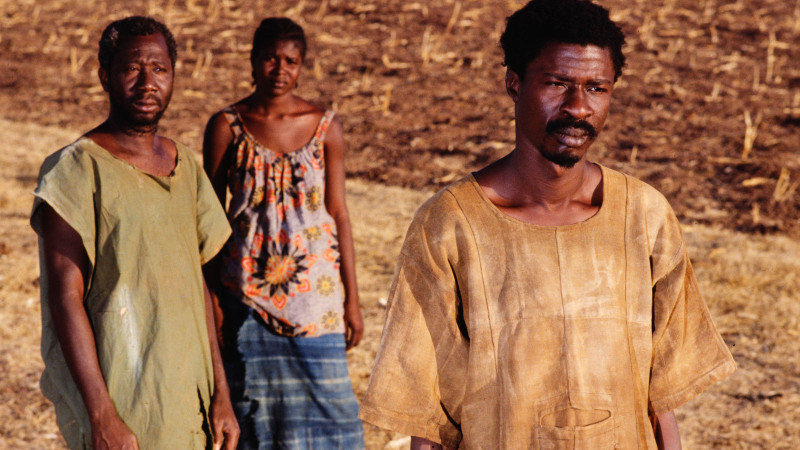

This gentle and ominous fable rather remarkably won Idrissa Ouedraogo the Grand Prix at Cannes in 1990.
There is something timeless about this story, although it is a deeply rooted in a misogynistic and shame-filled society.
In a remote village in Burkino Faso, Saga (Rasmané Ouédraogo) returns after two years away, triumphantly signalling his return by blowing his horn from a nearby rocky outcrop.
Two years is too long it would seem as the woman promised to him, Nogma (Ina Cissé), has been married to his father in the meantime and is now his mother. His brother Kougri (Assane Ouédraogo) dolefully passes on this news and to everyone in the village it feels like an unfortunate but totally acceptable turn of events. After all Nogma was originally promised to his father and so it’s his prerogative to change his mind.
Saga is so upset that he leaves the tribe, which is something of a slap in the face for his father. He doesn’t go far though, and in a hut he makes nearby, Nogma eventually visits him and declares her love and body.
I think we know this is not going to end well because everyone is so serious about traditional expectations despite anyone’s happiness or a reasonable argument. The characters have a habit of sucking air through their teeth to show disdain, and it felt like an African ‘whatever.’ I could imagine this story retold with contemporary teenagers.
I feel like I might have seen this back in the 90s and it might have landed a bit more strongly with me then. It would’ve been probably the first film from Burkino Faso that I had seen and it might not have seemed quite so quaint.
Each scene is quite static with lines delivered amid comfortable pauses. I assumed it was a satire – how could the ridiculousness of men making bad decisions due to pride and women being possessions be anything else? I’m not so sure though, having done a bit of searching for information about the film since the screening. There is some humour there, although it is hard to see from my perspective here and now whether it was intentional or not as much of it seems shocking now.

