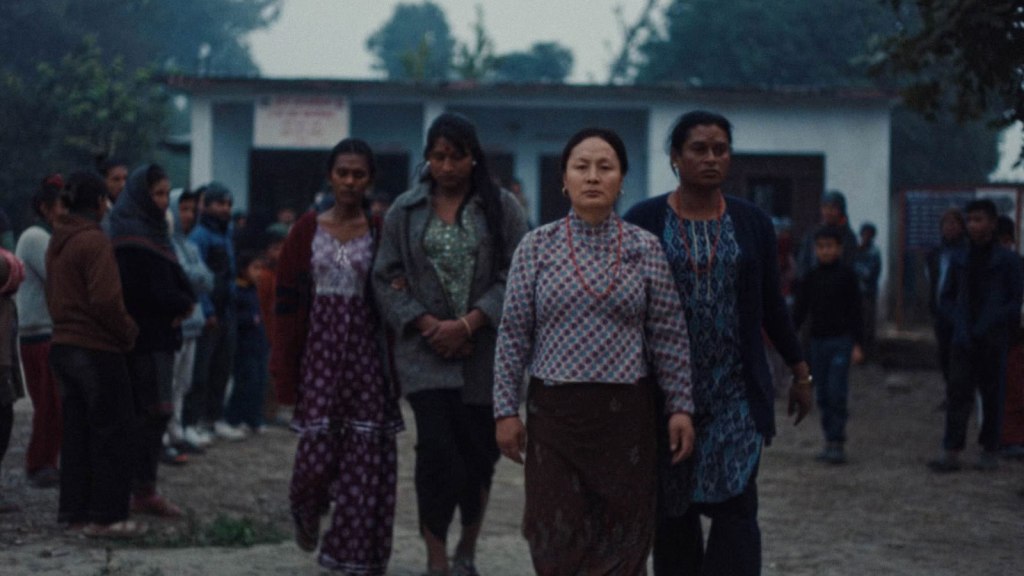

A fascinating look at an ancient culture of gender queer spiritual power in Nepal.
The Kinnar people are considered a third gender in Nepal. Seemingly people assigned male at birth, they choose or perhaps have chosen for them, this spiritual path. They live as women, taking vows of chastity and being given the power to bless and curse. They live in houses with an appointed mother who mentors and supports her daughters. Called upon by villagers to help with marriages, fertility and financial success, as might be expected in a largely patriarchal culture, they are only tolerated up to a point.
In this particular village that is on the edge of a forest and at risk nightly of wild elephant attack – the at first literal depiction of the elephants in the fog – we see the house of mother Pirati (Pushpa Thing Lama) and the normal family dynamics of siblings who don’t always get along or do what they’re told.
The most wilful is Apsara (Eliz Ghimire), who seems to struggle against the restrictions, and dreams of a life elsewhere. She is not alone in flouting the chastity rule, and one night after a fight with Pirati, she disappears in the forest.
This is where we see where the Kinnar rate within the community, particularly in a superstitious society. They struggle to be taken seriously and that Apsara was a former sex worker seems to make her not worth the effort to keep searching, particularly when suspicion is cast upon a married man.
Pirati is our centre, and for her it is a journey, not just about what she wants out of life, but about stepping into her role of mother. Director Abinash Bikram Shah – this is astonishingly his first feature – said in an interview for the Cannes Film Festival (see a PDF here):
Pirati and her daughters live in Thori, a village cradled by the forest. While beautiful, it is a place of isolation where everyone’s business is known. In a small community like this, it is hard to have a private life. Her lover, however, lives in Birgunj, a major border city. Birgunj is the total opposite: it is a landscape of concrete, heavy traffic, and the chaotic energy of an industrial hub that never sleeps. Ironically, the city offers Pirati a different kind of sanctuary. In the noise and crowd of the city, she can hide in plain sight. Because everyone there is so busy with their own lives, she can meet her lover without being judged or even noticed. For Pirati, traveling between these two places is more than a commute; it is a movement between two different states of being. She is caught between the community that shaped her and the promise of a “normal” life where she can finally be anonymous.
This is partially based on a real story – the death of a trans women that shifted quickly to a condemnation of her (does that sound familiar with our news feeds full of the Sydney Swans ‘incident’?) – and also finding joyful tiktoks of Kinnar women living their best lives that then draws trolls and vile commentary.
The wild elephants are on the periphery and yes, they are something of a metaphor. The director in the Q&A talked of the elephants representing the Kinnar – revered as sacred with the elephant god Ganesh being one of the most loved gods in Hinduism but as soon as they are wild and cross the line from the forest and impinge on the village, they are a force to be destroyed. The final scene is emotionally powerful, elevating the story and the sense of magic that goes with the Kinnar powers into something that allows you to transcend their often awful reality.

