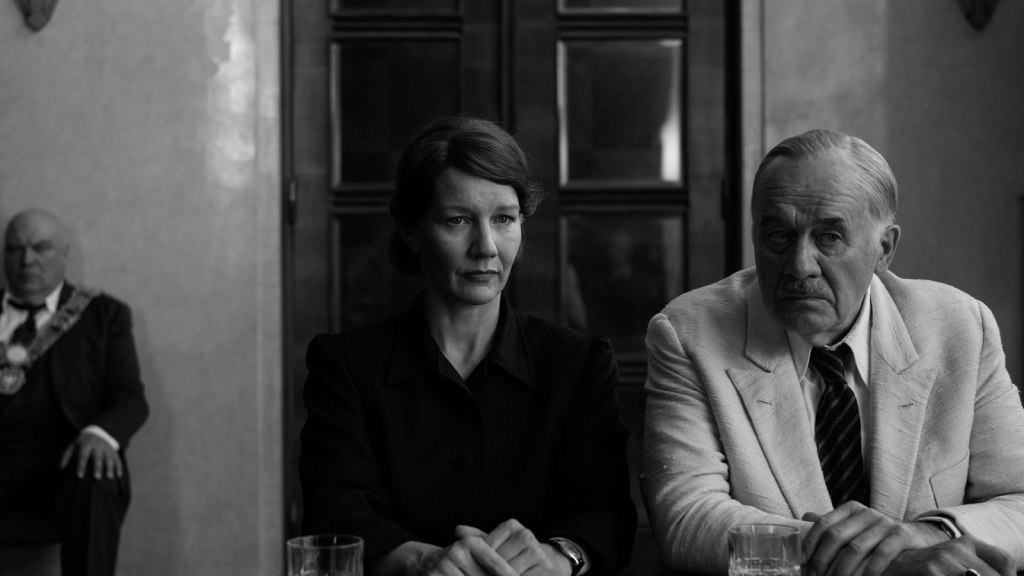

This feels like a perfectly crafted film. As my friend Ariel said, not a single second is wasted. And at only 82 minutes, it shows how well you can tell a story without making it an epic.
Director Paweł Pawlikowski made Cold War (2018) and Ida (2013) and knows how to make the most of gorgeous black-and-white tones and a layered story. This one is based on real people, the writer Thomas Mann (Hanns Zischler) and his daughter Erika (Sandra Hüller). It is 1949, after the end of World War II, and Mann has been awarded two accolades celebrating Goethe, the German poet.
Erika works as his assistant and they travel to Frankfurt for the first celebration. What is more controversial is the second celebration to be held in Weimar, which is now in East Germany. There is much concern about what this will do to their reputations back in their new home of America.
Also on the edge of the story is Thomas‘s son Klaus (August Diehl), also a writer but one whose works are not quite so celebrated as they embody queer themes (he wrote Mephisto).
This really is as much of the plot as you need to know, as what is so great about the film is not so much the beats of the narrative but the small moments where we are shown the political pressures and the impact they have on personal relationships.
In there are themes of the ego of the artist, the role of the artist in provoking change, the personal suffering for those who speak out, the complicity of those who have lived through a war, and what is perpetuated afterwards.
Some of what you see and understand is almost wordless, like the quietly sublime ending. And all captured within the almost square frame that gives you all the dark and light and beauty and destruction.

