
What a debut feature! Rakan Mayasi has crafted a film about a little known culture (in my country) that feels like scripted drama but was made collaboratively with Bedouin communities and the film’s many non-actors.
There was a false start to this film when the cinema inadvertently left the house lights on as the opening scenes unfolded. The first scene is that of a burning car, slowly coming into focus with vivid orange against black. When they fixed the problem, they started the film again and so we got to experience that scene without distraction.
Opening scenes often feel inconsequential, we’re not quite locked into our experience with the film and so perhaps don’t focus on them or realise their importance.
We find out the significance of this one a little bit later, a Bedouin family living on the border of Lebanon is searching for one of their own, Gamra, a young woman who has disappeared. She was unhappy when the man she loved was married to someone else and is suspected of being the one who set fire to the car before fleeing, perhaps over the border to Syria.
Looking for her are her cousins, sisters Jawaher (Jawaher Al Mawla) and Rim (Rim Al Mawla) and their brother Yasser (Yasser Al Mawla). When Yasser accidentally knocks down a man from a different tribe, deeply traditional beliefs and rivalries emerge.
Mayasi, according to IMDb, is “an independent Palestinian filmmaker, currently based between Brussels and Beirut. He grew up in Amman, Jordan and then went on to study cinema, theatre and psychology in Lebanon. He later received film training with Abbas Kiarostami in South Korea at the Asian Film Academy.”
In a Q&A afterwards, Mayasi talked about the Bedouin people who live straddling the border of Lebanon and Syria. They don’t believe in borders, don’t have passports, and are able to travel on non-state roads between the countries. It means also that they are seen as odd, and not part of the local people. Jawaher works as a nurse and Mayasi observed that she would change her accent when she would go to work to better fit in.
As we see the blood feud between the two tribes emerge, we get a sense of what some of these traditions mean. Women don’t have real agency, sometimes given the illusion of choice without it being real. We see this when a solution to avert retribution by the opposing tribe is for the two sisters to be given over to the sheikh of that tribe. They are given a choice which is not really a choice.
Mayasi was prompted to develop the story because of the experience of his grandmother being forced to marry at age 14. He wanted it to be authentic and so worked collaboratively with Bedouin communities, coming across Jawaher by chance and, rather remarkably, she and her siblings and parents all agreed to be part of the film. As non-actors, they are completely convincing in their mostly fictionalised roles.
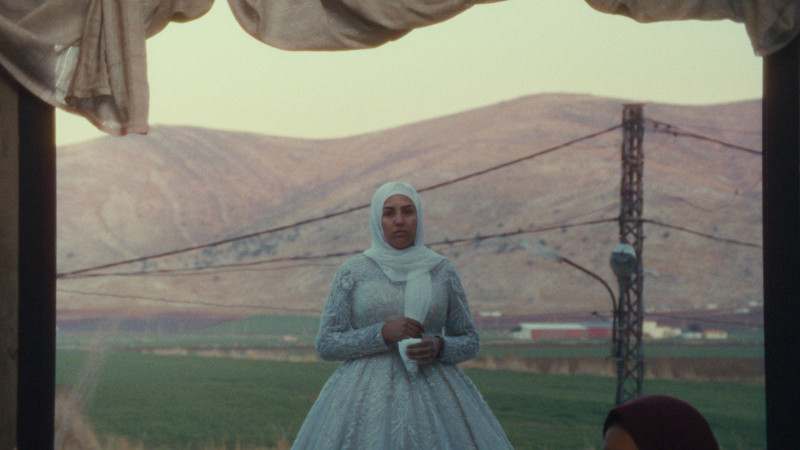
There is a slowness to how the story emerges, and we have some static and slowly moving shots that are specifically framed to create almost a tableau. The ones that stick in my mind are the reveal in the window of one of the sisters in her white outfit (image above), the zigzag road across the stony land, and that final telephoto shot holding on the cypress tree as we sit and contemplate the future of the characters.
The themes are presence and absence, individual versus tribe and although there doesn’t seem to be a strong judgement – even those who are acting in ways we don’t agree with seem to have some sense of honour – I think there is an underlying criticism of the misogyny and the inflexibility of the system. For a people who move so freely, they seem to be so bound by expectation and rivalry.

