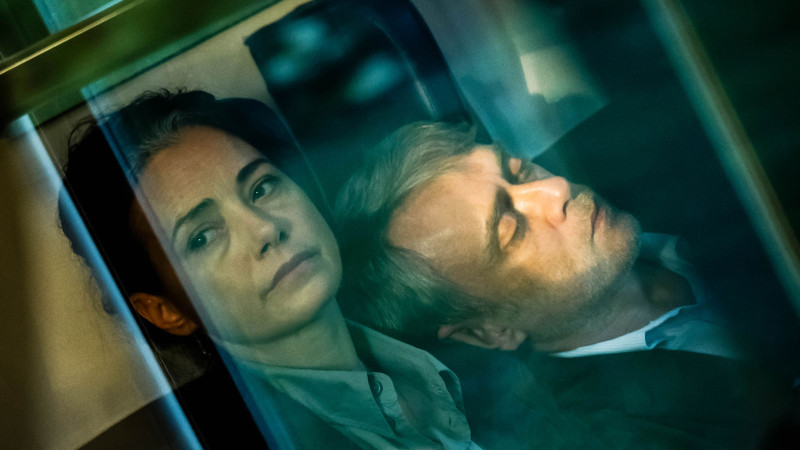

This hooked me from the moment it showed a dramatic title card that made it clear that it was being filmed in Berlin but we should consider this was Ankara in Turkey.
Like with Petzold’s Transit (2018), I really like that trust that director Ilker Çatak shows in the audience to understand and accept why this might be necessary and how it speaks to the themes of the film. Because this is about standing up to a totalitarian regime.
Comfortably privileged creatives, Aziz (Tansu Biçer) and Derya (Özgü Namal) are feted by the public and powers that be for their performances and plays at the State Theatre. They have a comfortable life, a volatile teen daughter Ezgi (Leyla Smyma Cabas), and Aziz enjoys his position as a university lecturer.
There are protests happening, against war and homophobia and transphobia and the government, and an interesting early scene sees Aziz walk-through one to his class. It’s only at the end of the film that I look back and see the comfort he has being an ally but not really ever being affected by the oppression he thinks stands up against. in his art
Derya is feisty and angry and used to being able to speak up. They are both blindsided by yellow letters that appear, sacking Aziz and his more left leaning colleagues from their jobs, and shutting down their play. Suddenly the powerful become persecuted.
We are with them though, perhaps seeing a little bit of our ourselves in them and recognising that it is easy to be an ally but harder to actually live the life of the persecuted. They try and protect daughter Ezgi from the reality, which often results in her feeling entitled to complain about how hard her life has become.
They are forced to relocate to Istanbul to live with Aziz’s mother. He takes on a job as a taxi driver and she is tempted to lower her standards and take on a role in a soap opera.
It’s quite a long film, but as it digs deeper and deeper, I started to see some layers that I was oblivious to at first. I thought maybe we were just going to see them get their day in court and have some form of redemption but that’s not really what this is about.
I suspect there’s a lot being said about patriarchy and masculine and feminine roles in Turkey. Derya in particular emerges as a woman who just won’t be quiet and, although she can be infuriating, we can’t help but admire her. And eventually the layers are peeled back where we see that Aziz, for all his progressive thinking, is struggling not to be ‘the man.’


Pingback: Parallel Tales (2026) | fillums