
It was with a small amount of trepidation that I saw this latest from one of my favourite directors Asghar Farhadi (or as Facebook autocaptioning calls him, Glasgow Harvey).
Before the film, I worried that success might make the work of a male director more bloated and watered down. Male because there is so much about the system that builds them up and buffers them from criticism and having to prove themselves.
After the film and a quick chat about problematic news about Farhadi that I seem to have missed – accusation of plagiarism by female film students that he was acquitted of in court – I worry that he is one of those film bros who believes strongly in his own importance.
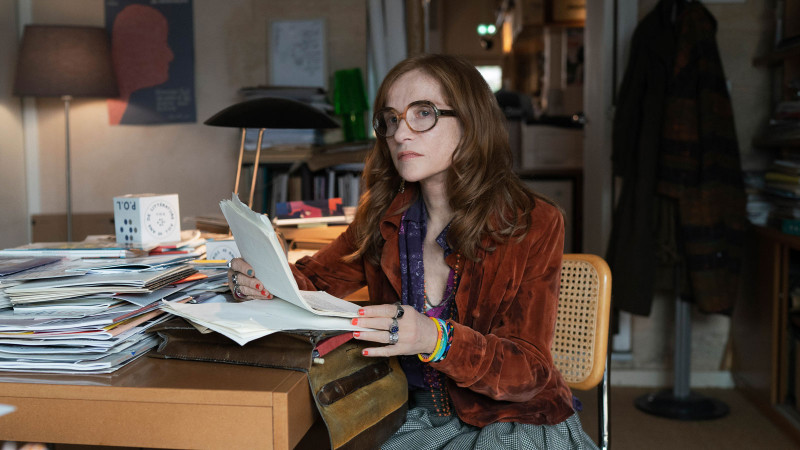
With Parallel Tales, although the production names all sound Iranian, this is set in France and feels very French. It is loosely based on Krzysztof Kieślowski’s A Short Film About Love, set in contemporary France and pivoting around a scratchy and dissatisfied ageing writer Sylvie (Isabelle Huppert).
Although she provides a welcome centre to the film, her character is something of a dynamic prop, setting up the framework for the story without really being part of the narrative arc.
She lives in a high up apartment and her newly pregnant niece Laurence (India Hair) is urging her to pack up and move. We later learn that this is because they have both inherited the apartment and Laurence wants her share. Laurence is helped by a random guy Adam (Adam Bessa) on the metro, intervening when her wallet is stolen. As a thank you, she organises for him to help Sylvie and so he becomes enmeshed in her latest story.
Across the road from the apartment is the place where Sylvie‘s mother lived and she starts to obsessively watch the apartment with a small telescope, a nod to the Kieślowski film. She starts creating a story around the people she sees there – brothers Nico (Vincent Cassel) and Theo (Pierre Niney) and Nita (Virginie Efira) who have a sound recording studio in the apartment. Sylvie concocts a thriller of jealousy around their relationships. The reality is much more mundane though, but Adam’s obsession with watching Nita starts to spill over into their reality.
For a while the parallel tales and overlap between what Sylvie is writing and what is happening becomes a little bit disorienting. Stick with it though, as the difference between the real and the fictional characters starts to become more apparent. I appreciate that Farhadi often has female characters with a sense of agency around their lives, even if this doesn’t quite match others expectation of them. There is a theme of men obsessively stalking women, which is not quite the same as Sylvie‘s watching of the neighbours as she never makes this something that impinges on their lives.
Farhadi seems to be looking at this with a somewhat dispassionate eye, noting that it is not fair and that is not right but that’s it probably will be overlooked with the right kind of apology and in order to meet one’s own needs.
The Farhadi films I love are the ones that pack a punch in the third act. There is often a rather bleak ending and so doesn’t sit so well with mainstream audiences. The audience of this screening laughed a lot at scenes that didn’t feel essentially funny, and gasped and murmured at sudden revelations. If I had come into this with different expectations, I might have been less underwhelmed by the ending.
If I step back and look at what is perhaps being said here, it seems to be about the blurring of reality and fiction, The Butterfly Effect where one small thing we do can have a profound effect elsewhere, the inability of men to understand and respect boundaries, and the sonder of our everyday lives where there are an infinite number of dramas playing out around you.
Minor spoilers below
Is anyone changed or transformed through this story? Adam isn’t, even though he is given understanding and comfort. Sylvie isn’t, she refuses to change how she thinks or what she writes or where she lives. Nico and Theo aren’t, faced with harsh truths that they would prefer to ignore or excuse. Perhaps Nita is the only one changed, but not in a good way. She goes from someone hopeful to someone punished for the transgressions of others.
I had a really interesting chat with someone in the queue at my next film and we talked about how, if this story had been set in Iran, the outcomes for some of the characters would’ve been much different and more bleak. With Farhadi’s early films he makes us sit with a moral quandary that often doesn’t have an easy solution. As this is set in France, it feels like there is a need for it to be gentle and more mannered. It makes me think of Yellow Letters where we are being shown one country but having the story set in another. I think I would’ve liked a little bit more of Farhadi’s Iranian social sensibilities to come through.

