
Sad sad sad sad. I think I knew this was going to be about queer sorrow rather than joy, although I was drawn in by the period setting and Fiona Shaw.
If you have seen The Children’s Hour (1961), you will know the story. The difference with this one by Sophie Heldman is that it is based on the actual story that has inspired novels and plays.
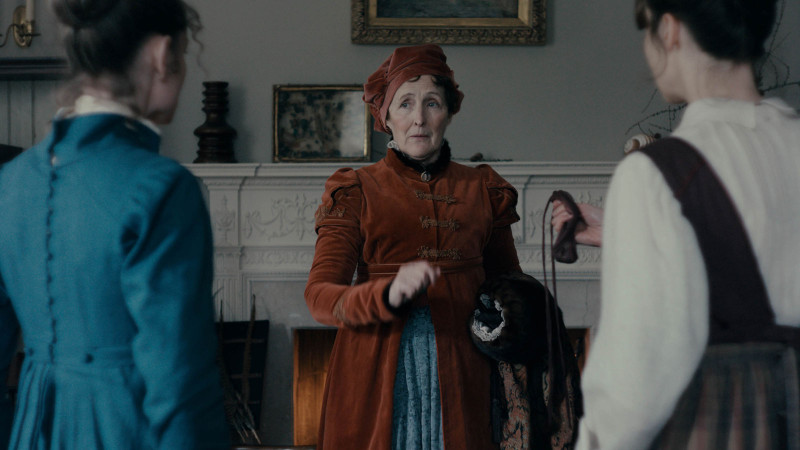
We are in 1810 Scotland and privileged Lady Cumming Gordon (Fiona Shaw) is crossing the Scottish countryside in a carriage with her two granddaughters and another young girl who we can see is being treated not quite the same. They are going to the newly open school of two young women, Miss Woods (Claire Dunne) and Miss Pirie (co-writer Flora Nicholson).
It turns out that the third girl, Jane Cumming (Mia Tharia) of the title, is also the granddaughter of Lady CG but the illegitimate child of her son and an unknown Indian woman. So we are seeing racism so entrenched that everyone understands it and complies. At the school she is targeted by her older cousin Margot (Amy Louise Walker) and ostracised.
Miss Woods and Miss Pirie though, are kind souls and they take her under their wing, trying to build up her confidence and give her purpose. This includes looking after her over the summer holidays so she doesn’t “distract” from Margot’s coming out into society in Bath.
Another thread is the attraction between the two teachers. Driven mainly by Miss Woods it would seem, with Miss Pirie praying hard each night, perhaps wanting to pray the gay away.
Where it all goes bad is when Jane, in a moment of pain where she wants to hurt those who have hurt her, tells a lie about the two teachers. This starts a chain of events that sees the destruction of the school.
I really enjoyed this while watching it, although I knew all the time that it was heading somewhere depressing. The setting and characters are all fascinating and Fiona Shaw is wonderful as the outraged lady of privilege.
It made me think about the purpose of remaking films that show being gay as something that is a burden. I understand there will be generations who haven’t seen The Children’s Hour, and in some ways I think this film is made for a largely mainstream audience, so perhaps the story will enlighten.
It would’ve been interesting though to take it perhaps from a different point of view. I expect that much of the story beyond the eventual court case is not documented and has been filled in by fiction writers, including any actual relationship between the two women.
It might’ve been interesting to focus more on Jane, although she is given much more depth and empathy than the child in The Children’s Hour. Or we might have spent more time in the queer joy of a relationship between the two teachers so that the eventual devastation is balanced with something more fulfilling. Or maybe I’m overthinking it.

