
The Melbourne Film Festival is doing a strand of films by Ulrike Ottinger this year and, not knowing anything about this director, I was drawn in by this one being set largely in inner Mongolia at a time where no western directors had previously been allowed to film there.
There is a painted, artificial stylisation to the first half of the film, which contrasts strongly with the second half which feels almost documentary in its authenticity.
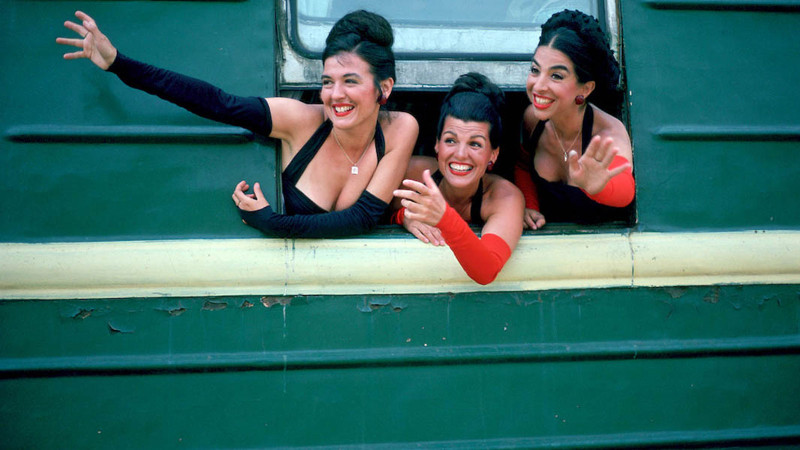
We are on a train with a bunch of characters who are being played at level 11. Theatre types who are happy to break into song, a gourmand who is used to getting any food he wants, and rich genteel women who are privileged enough to be able to travel the world.
There is Lady Windermere (Delphine Seyrig), who takes a young traveller Giovanna (Inés Sastre) under her wing. There is Fanny Ziegfeld (Gillian Scalici) who is a Broadway star who seems to be irrepressibly happy and eager to sing. There is prim secondary-school teacher Mueller-Vohwinkel (Irm Hermann) who is a fish out of water on the Transiberian and then Transmongolian train. There are the Kalinka sisters, a trio always ready to break into harmonious song.
The train setting is artificial, deliberately so, and we are cut off from the world outside as these people focus inwardly on their adventures. We see little touches of the political situation, with a pompous and garrulous military officer talking about the unruly Mongols that he must pacify.
At about the halfway point, the train is forced to stop by a Mongolian princess Ulan Iga (Xu Re Huar) with her female warriors and the women aboard are captured. It’s not a violent capture though, they are encouraged to become part of the Mongolian tribe for awhile and they mostly eagerly. It’s a part of their big travel adventure.
This is where the film changes gear and from now on we are in something of a Mongolian documentary. We are told stories, we watch the traditions of the Shaman, the ritual killing of animals, the cultural traditions and how they show respect to the earth. It is mainly a world of women, although there are some delightful scenes towards the end of men on horseback and dancing.
There are small threads of story with our original characters but, thankfully, these are kept as minor narratives that don’t overshadow the rather fascinating look at the inner Mongolian people.
At more than 2 1/2 hours long, it did start to drag towards the end and I wouldn’t have minded if it had been trimmed back just a little bit. On the whole it’s an odd film, and probably will divide people as to which half they like best.
I think perhaps it is saying something about the artificiality of civilisation and the natural beauty of indigenous life. Ottinger went on to make an eight hour documentary Taiga about Mongolia and this feels like the first act.

