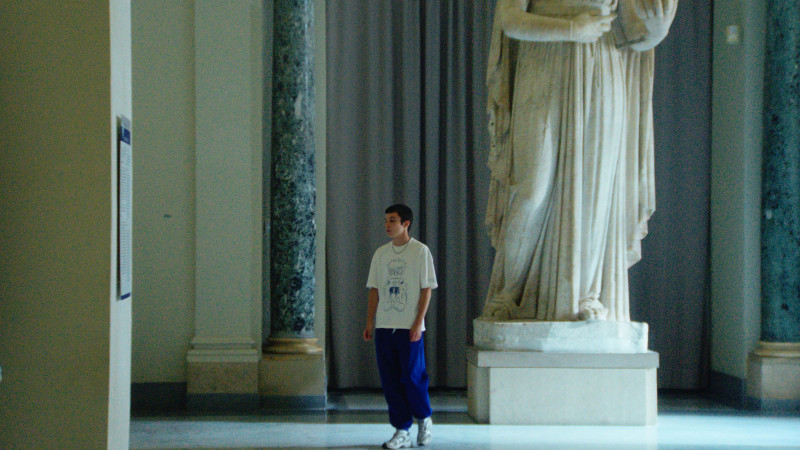

This is the first film of the festival so far where I felt completely emotionally enveloped by its story.
We are on a bus trip of high school students, all on the precipice of graduating, travelling to Pompeii with their teacher Mme Mercier (Antonia Buresi). It is your usual mix of teens – ones from wealthy backgrounds, loudmouth boys who keep interrupting, studious girls who fade into the background, and the restless undertones of emotions and status.
There is James (Mitia Capellier-Audat), privileged and handsome who seems to be able to get anything he wants without much care. His best friend is Toni (Colas Quignard), who we can see is in love with him. The fact that he’s gay isn’t hidden, and James keeps him close but obviously doesn’t return his romantic affections. In the background is Suzanne (Suzanne Gerin), who sees herself as ordinary and unlovable but is obviously bright and used to being made fun of.
We follow the students as they go up Mt Vesuvius and we hear a lesson on volcanoes. They go to Pompeii and see the plaster casts of bodies at the time of their death. There is a lengthy scene where they discuss a mural of a Dionysian cult celebration and bicker and banter about its meaning.
The interactions and discussions seem natural and what we would expect from teens. A lengthy discussion over a dinner about the worth of teachers accentuates the different origins of each student and their understanding of what to expect from the world.
The experience of Toni is the one that we focus on the most. He has the most excitement about the trip because his mother has told him the story of his origins. His grandmother fell in love with a rich man in Naples but was devastated when he was killed in the 1980 earthquake. She was pregnant and had to flee back to France. Toni is hoping to find members of his family here. For him it seems to be the one special and interesting thing about himself that he hangs onto. He is not doing well at his studies, too easily distracted and playing the fool to really knuckle down and get the work done or take it seriously.
There are some themes at play here, a lot about the sense of self we have as a child and a teenager and how that carries us through to the adult world. About how things seem to be getting harder, for teachers, for people, although we then see the context of Pompeii and how things may have been even harder in the past.
There’s also a thread about how we hide what we want to say and do. About the emotions that are under the surface that we don’t feel we can speak up about, maybe because of concern about what other people will think about us, or our status.
I have a feeling that director Marine Atlan found first time actors for the key roles – the way the camera follows them and lingers on them feels very organic. You really get a sense of that sun drenched Italian life, and the moments where we focus on Pompeii‘s past seems quite visceral, although to teenagers perhaps they feel it is something anachronistic.
I found the ending very emotional, it’s something that is underplayed. It is interesting that we get an epilogue from Suzanne, a character who seems to have been in the background for a lot of the film, someone we find out the least about.
Curious about the meaning of ‘la gradiva’ I found that it translates as “She who steps along” and is from a novel of that name about an enigmatic female figure in a Roman relief. This harks perhaps to the Pompeiian mural, but it was a novel that then influenced Sigmund Freud and Surrealists like Dali (he nicknamed his wife Gradiva). Maybe this is about the elusive dream that Toni is chasing, or perhaps it shows that Suzanne is the only one who will ‘step along’.

