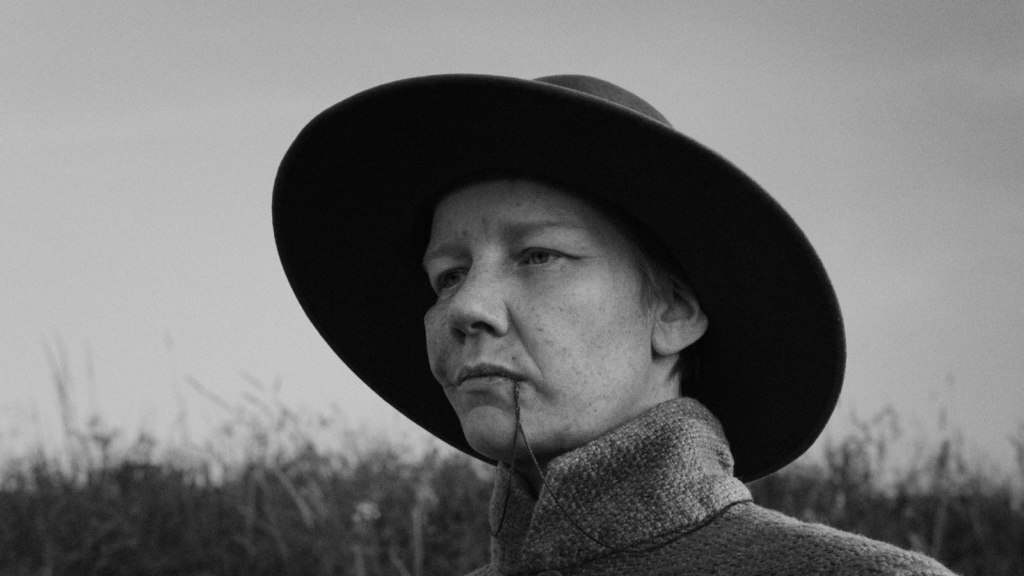

You know I love a black-and-white film, and pretty much any film with Sandra Hüller.
This unfolds like a true story, narrated as some sort of dark fable. Set in 17th century Germany, we see the arrival of Rose (Hüller), a woman who has been masquerading as a man through 10 years as a soldier. She has arrived at a place where she has documentation of proof of her inheritance of the farmland.
The 17th century was probably a suspicious and superstitious time, and her oddness of build means that the locals feel slightly uneasy around her. When she completes an act of heroism though, they accept her fully and she is free to follow her ambitions and build up the success of the farm.
During the Q&A after Sweet Milk Lake, there was a question about trans films having a repeated trope of masquerade. This didn’t seem to be so true for that film but it’s definitely a key element here, as the tension builds with our fear that she will be unmasked.
We don’t really get to know any of the other characters except for Suzanna (Caro Braun), the young woman who rose, a.k.a. the master, is forced to marry. What develops slowly is an understanding of what it is to be a woman and the headiness of being given agency, even if it is limited.
I’m not sure why the black-and-white cinematography recalled Anchoress (1993) to me. Perhaps it is the rich tones and darkness of the black-and-white imagery and the quiet acceptance of fate.
Hüller is excellent as someone who has learnt to adopt masculine voice and confidence and physical traits. Although this isn’t necessarily telling a story of a trans person, it definitely feels queer and feminist in its themes.
Director Markus Schleinzer said in an interview here that as a queer person himself, he has always explored queer identity and history in his work. “So, from the very beginning, writing this screenplay was a political endeavor for me.”
Mentioning that he was raised solely by women, Schleinzer added that he believes “that the only thing that could save us right now is if we had more feminism in the world, and returned to the fundamental principles of feminism.”
Women’s inequality remains a persistent global issue, gender-based violence is rising and transgender rights are one of the most polarizing issues in the current political discourse. For Schleinzer, even though “Rose” is a historical drama, “in reality, it also tells a story about the present time we live in.”

