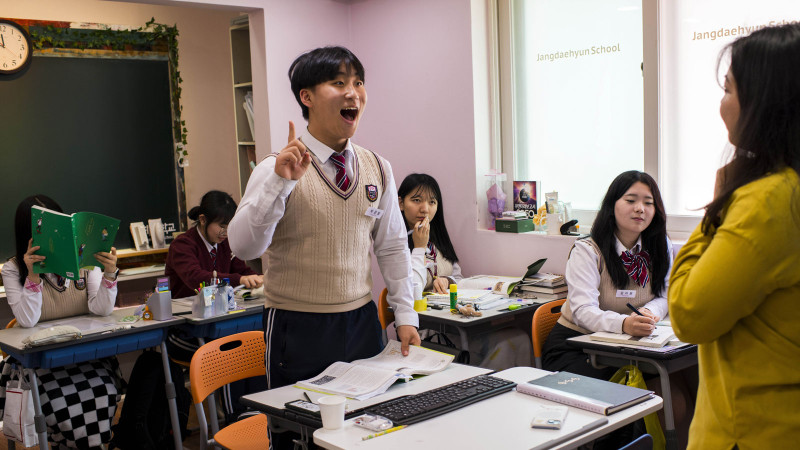

Well, this one snuck up on me. It feels like a pretty standard documentary, set in one of a handful of schools in South Korea that are set up specifically for the children of defectors from North Korea.
Directed by Jeremy Workman – who made one of my fave 2024 documentaries that inspired me to create an art space, Secret Mall Apartment – the school, Jangdaehyun, is one of the smallest ones, with only 20 students. It is a boarding school which they feel is an important aspect of helping the children acclimatise to South Korean culture and build the best opportunities for their future.
At first that approach seems a little bit overbearing but the focus of the school is quite interesting. They support academic success, something that is very important in South Korea, but prioritise all those other values that are important. Self-confidence, ambition, self determination and direction, being a good citizen.
We see some new students being interviewed and also meet students in various years talking about what it is like being in the school. So far so mid.
But then they show a group of students with a book project, who have decided to interview different people about their experiences with defecting. They talk to students, past and present, and also decide to talk to some of their own parents.
What becomes apparent is that some of these students have never heard the stories from their parents. And some admit to actually feeling ashamed of having defectors as parents. We know by this point that many of them have escaped endemic bullying in different regular schools, where being from North Korea is seen as something lesser.
I had a good chat with my friend Lowell as we walked between cinemas after the film. She grew up in South Korea and she talked about how normal it is to be ignorant about people from North Korea and to be dismissive of them.
And through the interviews that the students conduct, particularly with family members, we start to hear some really really harrowing stories of the realities of fleeing a country where to be captured is worse than dying. One interview in particular with a father is where the emotional level of the film shifted for me. You’ll know it when you hear it.
From that point on there was such a heartwarming connection with these young people heading off into the world that it was hard not to be moved by it. There are some beautiful moments – when they dance on stage, when they get university admission results – that will affect you deeply, or rather that affected me deeply.
I saw a documentary a year or so ago that showed North Koreans escaping over the border into Laos and Thailand so I felt I knew something of the dangers. But to see a teenage boy talking over a secret phone call to his older brother who he has left behind and hearing the raw emotion brought it home to me in a way that the other film didn’t.

